

In 1926, the U.S. government went looking for a rancher named William Henry Bush.
Geologists had found something remarkable underneath his land outside Amarillo, Texas — a natural dome-shaped rock formation, sealed tight, sitting on top of gas so rich in helium it defied anything scientists had measured before.
Truth is, the Bureau of Mines ran the numbers and came back with a pretty staggering statistic regarding the Bush Dome.
It turns out that it held a hundred-year supply of helium.
Yes, you read that right.
For the record, that’s enough to secure America’s need for this strange, irreplaceable gas for an entire century.
So, we built and filled a strategic reserve, thinking that the problem was solved.
We couldn’t have been more wrong…
That gas has become a little-known critical ingredient to the future of AI.
To be fair, nobody in 1926 could have imagined helium cooling superconducting magnets inside a semiconductor fab, or stabilizing the lithography tools that etch the chips running today’s AI models.
That demand simply didn’t exist at the time, and it was nearly a century before it became so important.
Well, the clock has run out, and the world’s helium supply just took a major hit this year.
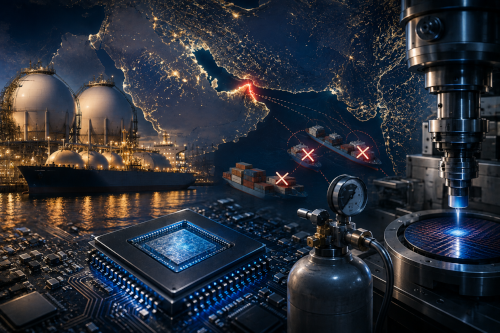
The reason most people haven’t caught on to this story is because it has been buried behind the much louder oil headlines.
Today, Qatar produces nearly 40% of the world’s helium supply, almost all of which comes from a single massive facility — Ras Laffan Industrial City.
Now, you know as well as I do that Ras Laffan is primarily an LNG operation. But helium is the byproduct, extracted alongside the natural gas Qatar is famous for exporting.
However, the moment Iranian missile and drone strikes hit Ras Laffan after the war erupted this spring, the damage wasn’t limited to oil and gas headlines.
Helium output at the facility dropped roughly 14%, and rebuilding the damaged units is expected to cost QatarEnergy something in the neighborhood of $26 billion.
Then the second blow landed…
The Best Free Investment You’ll Ever Make
Our analysts have traveled the world over, dedicated to finding the best and most profitable investments in the global energy markets. All you have to do to join our Energy and Capital investment community is sign up for the daily newsletter below.
You see, helium can only leave Qatar by sea, and more specifically through the dreaded Strait of Hormuz. Yes, this critical part of chipmaking is the same chokepoint that’s been effectively closed to Western commercial shipping since the war broke out.
Major carriers, including Maersk, MSC, Hapag-Lloyd, and CMA CGM, suspended their Hormuz crossings entirely, rerouting around the Cape of Good Hope instead. This added 10 to 14 days of transit time and roughly a million dollars in extra fuel costs per voyage.
Right now, roughly 200 specialized helium shipping containers are sitting stranded, unable to reach the buyers waiting on the other end.
And those buyers are exactly who you’d expect to be the most exposed.
We’re talking about South Korea, which sourced about 64.7% of its helium from Qatar in 2025. The country’s two largest chipmakers, Samsung and SK Hynix, were sitting on roughly six months of reserve inventory when the disruption hit.
One industry outlet described it rather bluntly, warning that a two-week clock was ticking down toward real production constraints (assuming the supply chain couldn’t realign quickly enough).
Although Taiwan’s TSMC is somewhat better insulated with a 3-6 month inventory and active helium recycling systems, this tech giant isn’t immune from the consequences.
Meanwhile, Germany and the broader EU electronics sector have flagged the same exposure, while Japan carries real downstream risk through its advanced electronics and medical device manufacturing.
In other words, this situation isn’t confined to one region or supplier relationship.
It’s the same chokepoint dynamic we’ve talked about for oil and LNG, just wearing a completely different shirt.
But the thing is, helium can’t be substituted, because it’s responsible for cooling the superconducting magnets inside advanced fab equipment.
The gas purges reactive gases out of deposition chambers, and stabilizes the pressure inside the microscopic environments where transistors get etched onto silicon wafers, at tolerances so tight that nitrogen or argon simply can’t do the job.
Let me be clear here… there is no plan B to chip production.
And the price action is already reflecting this panic, too.
After all, ultra-pure helium spot prices doubled within days of the disruption.
That means hard drives 10 terabytes and above, which seal helium directly inside the drive housing, saw prices jump as much as 30% from Seagate and Western Digital.
Keep in mind that this price jump was within a matter of weeks.
The Hidden Layer Beneath the Chip Crisis
Listen, every conversation about what’s constraining the AI buildout has focused primarily on one thing: Power.
By that, I mean the transformers, interconnection queues, and the reactors being built to feed data centers that can’t wait for the grid to catch up.
Even though those concerns are very real, it’s become apparent that helium is the quieter concern.
You can solve the power problem completely and STILL not be able to manufacture chips because the gas that makes the manufacturing process physically possible is mired at the heart of a war zone.
Now think about how this bottleneck behaves compared to a power shortage.
You see, a grid operator can throttle demand, stagger usage, or wait for a new transmission line to finally clear its queue.
But a chip fab running out of helium doesn’t have that luxury. The gas is either flowing through the equipment or the equipment isn’t running at the purity level advanced chips require.
There’s no partial fix here, and the industry knows it.
So, they’re doing what they can to adapt.
Air Liquide, for example, opened a new helium production facility in Taiwan back in April — direct proof that chipmakers are racing to build supply chains that don’t run through Qatar and Hormuz at all.
And that push for diversifying their supply through new extraction capacity, better recycling systems inside the fabs themselves, and renewed interest in helium sources outside the Middle East, is exactly the kind of shift worth recognizing before the investment herd.
Stay tuned.
Until next time,

Keith Kohl
 Check us out on YouTube!
A true insider in the technology and energy markets, Keith’s research has helped everyday investors capitalize from the rapid adoption of new technology trends and energy transitions. Keith connects with hundreds of thousands of readers as the Managing Editor of Energy & Capital, as well as the investment director of Angel Publishing’s Energy Investor and Technology and Opportunity.
For nearly two decades, Keith has been providing in-depth coverage of the hottest investment trends before they go mainstream — from the shale oil and gas boom in the United States to the red-hot EV revolution currently underway. Keith and his readers have banked hundreds of winning trades on the 5G rollout and on key advancements in robotics and AI technology.
Keith’s keen trading acumen and investment research also extend all the way into the complex biotech sector, where he and his readers take advantage of the newest and most groundbreaking medical therapies being developed by nearly 1,000 biotech companies. His network includes hundreds of experts, from M.D.s and Ph.D.s to lab scientists grinding out the latest medical technology and treatments. You can join his vast investment community and target the most profitable biotech stocks in Keith’s Topline Trader advisory newsletter.
P.S. The Hidden Income Stream Fueling the AI Revolution
Everyone is chasing AI stocks, but almost nobody sees the crisis unfolding behind the scenes: America doesn’t have enough electricity to power the AI boom. As Big Tech races to rebuild the grid, a little-known income opportunity tied to the companies supplying AI’s power could reward investors long before Wall Street catches on. Discover how to profit from AI’s biggest bottleneck before everyone else does.


