

There once was an unexpected blackout in northeast Ohio that left 50 million people in the dark.
I’ll even bet a few of my readers remember it, too.
In 2003, a FirstEnergy facility unexpectedly shut down. Yet, the cause for this blackout wasn’t your usual round of suspects.
No hurricane blew through that decimated the power infrastructure, nor was there some devious sabotage plot.
All it took was a group of overgrown trees and a damaged power line.
That was the spark.
And within a span of three minutes, 21 power plants across the region had gone offline. The situation exacerbated when the failure spread from Ohio to New York and Detroit, then north to Toronto, and on to Ottawa.
In total, 50 million people lost power.
Your humble reader was living in Cleveland at the time, and they couldn’t keep pumping water. All of a sudden, trains stopped, elevators went still, and cell service everywhere was disrupted.
Although things got back to normal within a few hours in some places, many had to wait for more than a day.
I bring this up because it taught us all a valuable lesson.
The lesson was that our grid was a very delicate piece of infrastructure, and it’s only as strong as its weakest piece.
This month, the Trump administration did something that would hopefully prevent a similar power crisis from taking place. 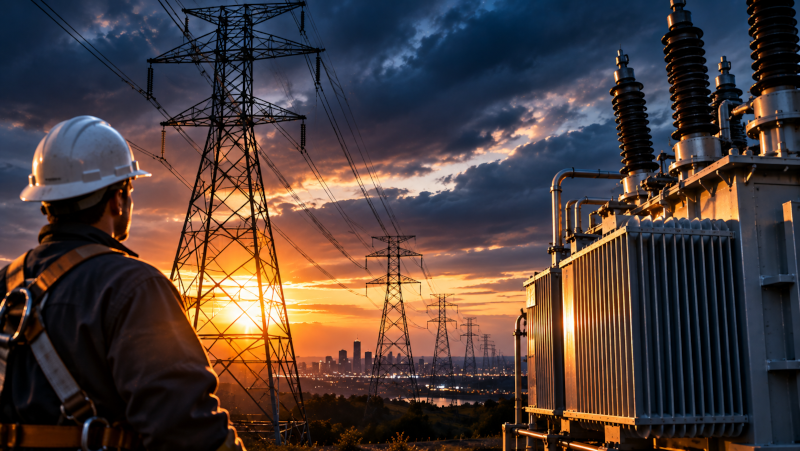
On October 12th, Energy Secretary Chris Wright signed an emergency order for PJM, the grid operator covering 13 states and Washington, D.C., that ran through October 16th.
Like in Cleveland, there was no hurricane or blizzard threatening our grid, just a few unseasonably warm days in the 70s and 80s, plus something far more boring.
And a calendar full of maintenance.
The Best Free Investment You’ll Ever Make
Our analysts have traveled the world over, dedicated to finding the best and most profitable investments in the global energy markets. All you have to do to join our Energy and Capital investment community is sign up for the daily newsletter below.
PJM said about 61,591 megawatts of generation was offline, most of which was from planned autumn work.
Despite the maintenance, demand was forecast at about 111,500 megawatts.
The tool behind this month’s order is Section 202(c) of the Federal Power Act.
Typically, this was a provision meant for true emergencies.
However, this time it allowed PJM to run certain gas, oil and coal units in a few states beyond their normal permit limits, including a 542-megawatt coal unit in West Virginia.
It also let the utility company direct backup generators at large customers. Around the country, the DoE has estimated that there’s over 35 gigawatts of unused backup generation sitting around the country.
But this wasn’t a one-off event.
The DoE has actually issued more than two dozen of these 90-day orders over the last year and a half, many of which kept plants open past their planned retirement.
Believe me, this comes with its own price.
But it also says meeting growing demand will take more generation, transmission and fuel delivery.
Consumers Energy spent over $248 million over the course of a year to keep its Michigan Campbell plant open; that’s about $642,000 a day, in case you were wondering.
Then the courts entered the picture.
Last September, a unanimous D.C. Circuit panel threw out the DoE’s order on Campbell, after judges found no emergency within the meaning of the law.
It turns out you can’t fake emergencies after all.
But we also can’t ignore the wires.
Just this month, the Department of Energy backed $581 million in physical upgrades to the wires and electrical infrastructure by the Tennessee Valley Authority, with $250 million coming straight from the federal government.
The funding covers 84 projects across eight states and would add about 2.5 gigawatts.
Of course, a separate effort would swap old lines for advanced ones over about 125 miles, adding roughly 1,900 megawatts.
That kind of upgrade may sound great, but it comes with one helluva catch.
You see, large transformers can take up to four years to get, and demand for them has risen 274% over the last 7 years.
And remember, the President declared an emergency last August over foreign-made grid equipment, which includes transformers, batteries and inverters.
That order gave the Energy Department 120 days to come up with a set of rules, and the tension has been building sharply since then.
Clearly the Trump administration wants to keep foreign gear off the grid, but we’re simply not there yet.
The emergency orders can only buy us a little time, and what comes next is the part to pay attention to.
Even though we’ll get a small, short-term cushion from the recent emergency orders, it’s kind of like trying to pull a lever overnight to fix the problem found at the core of our infrastructure.
That lever is a bridge, not a solution.
Yet, the market is still seemingly blind to what it would truly take to solve our grid’s problems. Of course, I’m talking about the physical materials — the steel, copper, and other resources that’ll take years to build, as well as the equipment that’ll take years to deliver.
And that, dear reader, is the key distinction here between a quick fix and a solution.
It’s why Hitachi has committed over $1 billion in investment, and Siemens is spending $421 million on a plant in Charlotte.
You can bet they won’t be the only ones, either.
Right now, utilities alone are expected to invest about $1.1 trillion between 2025 and 2029.
All we have to do is think a step ahead.
Until next time,

Keith Kohl
 Check us out on YouTube!
A true insider in the technology and energy markets, Keith’s research has helped everyday investors capitalize from the rapid adoption of new technology trends and energy transitions. Keith connects with hundreds of thousands of readers as the Managing Editor of Energy & Capital, as well as the investment director of Angel Publishing’s Energy Investor and Technology and Opportunity.
For nearly two decades, Keith has been providing in-depth coverage of the hottest investment trends before they go mainstream — from the shale oil and gas boom in the United States to the red-hot EV revolution currently underway. Keith and his readers have banked hundreds of winning trades on the 5G rollout and on key advancements in robotics and AI technology.
Keith’s keen trading acumen and investment research also extend all the way into the complex biotech sector, where he and his readers take advantage of the newest and most groundbreaking medical therapies being developed by nearly 1,000 biotech companies. His network includes hundreds of experts, from M.D.s and Ph.D.s to lab scientists grinding out the latest medical technology and treatments. You can join his vast investment community and target the most profitable biotech stocks in Keith’s Topline Trader advisory newsletter.


