

No one has built a new nuclear reactor in America on time or on budget for the better part of forty years.
We both know that regulators couldn’t change this, and utilities wouldn’t dare risk it.
At least, they certainly wouldn’t after Three Mile Island and watching Vogtle’s costs balloon into the tens of billions.
From a growth perspective, the U.S. nuclear industry was effectively dead, and they had one hell of a nightmare PR problem on their hands.
Then, AI showed up, and within two years, reactors started to get financed, restarted, and built faster than anyone in the industry thought possible.
And you know what? This week gave us all the proof we needed for nuclear energy.
I know some of the veteran members in our investment community here noticed when Google raised its 2026 capital spending guidance to somewhere between $195 billion and $205 billion — adding another $15 billion to an already record plan, in a single revision.
We’ve moved far beyond Big Tech simply looking to buy electricity.
These guys are financing power plants directly.
And that should be music to your ears.
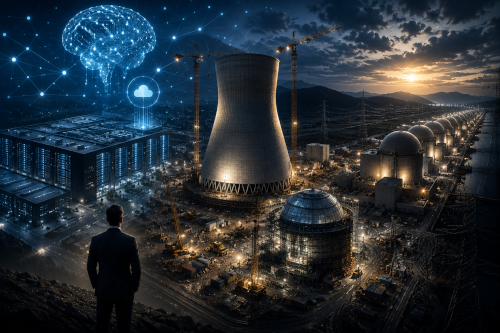
Today, every major hyperscaler has now signed at least one nuclear deal.
Read that again — every single one!
Remember, Microsoft has dished out $16 billion for a 20-year power purchase agreement to restart Three Mile Island Unit 1 — 835 megawatts, first power expected in 2027.
Then Amazon poured $700 million into X-energy for up to a dozen small modular reactors (by the way, that’s ON TOP of a $20 billion-plus nuclear-adjacent campus near the Susquehanna plant).
Meta has been the most aggressive of the bunch — up to 6.6 gigawatts spread across TerraPower, Oklo, Vistra, and Constellation; that’s enough capacity to power millions of homes, all dedicated to Zuck’s data centers.
And then there’s Google running the cleverest structure of them all. You see, Google adopted an “order book” model with Kairos Power, committing to purchase electricity from multiple small reactors as each one comes online.
That commitment alone gives Kairos the revenue certainty it needs to actually finance construction.
The Best Free Investment You’ll Ever Make
Our analysts have traveled the world over, dedicated to finding the best and most profitable investments in the global energy markets. All you have to do to join our Energy and Capital investment community is sign up for the daily newsletter below.
Add it all up and we get more than a dozen announced projects already, committing at least 10 gigawatts of nuclear capacity to the mix.
Are you starting to wonder why they’re in such a rush?
Well, the reason is because grid interconnection queues have backed up to roughly 2,600 gigawatts of stuck projects nationwide, with average wait times stretching five years or more.
Building your own reactor is now faster than waiting in line for someone else’s grid.
I know it’s crazy to think about, but keep in mind that the massive scale that we’re talking about is what’s driving this desperation.
After all, AI data centers are on pace to consume something in the neighborhood of 1,000 terawatt-hours of electricity in 2026.
Again, that’s roughly what Japan uses in an entire year.
And by 2030, something like a third of all data centers are projected to be fully off-grid — not connected to public infrastructure at all, running on power they built and own outright.
Reviving a 40-Year Old Dead Industry
Don’t get me wrong — none of this means AI’s power crisis is solved.
However, it does mean that the tech players with the deepest pockets on Earth are trying to buy their way around it, rather than waiting for someone else to fix it.
We simply can’t ignore the opportunity this creates for everyone standing downstream of the hyperscalers.
Of course, the other tailwind worth watching showed itself last month, when the U.S. and Canada jointly announced plans to build ten new reactors each — the largest coordinated nuclear buildout North America has seen in decades.
Are we starting to see policy finally catching up to what private capital has already proved?
The constraint is real enough that the richest companies on the planet decided it was faster to build their own power plants than wait for anyone else to.
You need to see the details behind this opportunity firsthand right here.
Until next time,

Keith Kohl
 Check us out on YouTube!
A true insider in the technology and energy markets, Keith’s research has helped everyday investors capitalize from the rapid adoption of new technology trends and energy transitions. Keith connects with hundreds of thousands of readers as the Managing Editor of Energy & Capital, as well as the investment director of Angel Publishing’s Energy Investor and Technology and Opportunity.
For nearly two decades, Keith has been providing in-depth coverage of the hottest investment trends before they go mainstream — from the shale oil and gas boom in the United States to the red-hot EV revolution currently underway. Keith and his readers have banked hundreds of winning trades on the 5G rollout and on key advancements in robotics and AI technology.
Keith’s keen trading acumen and investment research also extend all the way into the complex biotech sector, where he and his readers take advantage of the newest and most groundbreaking medical therapies being developed by nearly 1,000 biotech companies. His network includes hundreds of experts, from M.D.s and Ph.D.s to lab scientists grinding out the latest medical technology and treatments. You can join his vast investment community and target the most profitable biotech stocks in Keith’s Topline Trader advisory newsletter.


