

In 1877, the first transcontinental telephone line didn’t make the men stringing copper wire famous.
However, it did turn Alexander Graham Bell into a legend overnight.
Unfortunately, those workers hauling poles, smelting copper, insulating wire, and keeping the system from collapsing into a very expensive bird perch were mostly forgotten. That is usually how infrastructure booms work.
Not surprisingly, it’s the headline company that gets the spotlight while the suppliers get the invoices.
But invoices, as anyone with a working pulse knows, can be much more reliable than mythology.
Naturally, this brings us to SpaceX and its record-breaking IPO last week.
The moment the stock opened at $150/share, it was only a matter of time before the hype took shares to new heights.
And that’s exactly what happened.
By market close, it finished its first day up roughly 19%. That means that within a matter of a few hours, Wall Street had slapped a valuation of more than $2 trillion on Elon Musk’s rocket company.
It also made SpaceX one of the most valuable companies on Earth.
But is that valuation justified, or does it sound a little absurd given the media hype that surrounded it?
I’ll let you answer that one for yourself.
What we do know is that this is a company that generated $18.7 billion in revenue last year; Amazon, by comparison, generated $716.9 billion.
So yes, investors are paying an extraordinary premium for the dream.
But here’s the part I don’t want you to miss…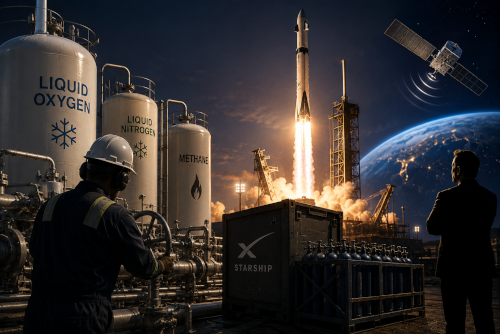
Look, just because the stock is expensive doesn’t necessarily mean the underlying opportunity is fake.
It only means the best trade opportunity may not be SpaceX itself.
Perhaps something better is lurking deep in the shadows of Musk’s space trade.
The Best Free Investment You’ll Ever Make
Our analysts have traveled the world over, dedicated to finding the best and most profitable investments in the global energy markets. All you have to do to join our Energy and Capital investment community is sign up for the daily newsletter below.
Finding the Fuel Behind the Fire
Every single rocket launch SpaceX executes begins long before the countdown.
Long before the engines light, before the booster clears the tower, and before the cameras show that beautiful pillar of fire under the vehicle, there’s the quiet industrial work nobody wants to talk about.
Gases have to be supplied, oxygen needs to be separated, and nitrogen has to be secured — cryogenic systems have to be installed, maintained, and scaled.
Believe me, that work is far from glamorous. And the players behind the curtain won’t be the ones ringing the morning at Nasdaq.
You won’t see anyone making a movie about the guy managing bulk gas logistics at a launch site.
But it’s absolutely essential to SpaceX’s success.
And right now, one specialized corner of the industrial gas market sits directly behind SpaceX’s launch machine.
See, a single major industrial gas supplier supports the bulk of SpaceX’s launch activity and earns hundreds of millions of dollars annually from the space market. That’s still a modest piece of a giant industrial business today, but the direction of travel is what matters.
Why? Well, because Falcon 9 was only the beginning.
And Starship changes the math completely.
Break it down a little further with me…
Falcon 9 burns liquid oxygen and RP-1, a rocket-grade kerosene. Starship burns liquid oxygen and methane. But Starship is a much larger vehicle — bigger, heavier, more powerful, and designed around a future launch cadence that would make today’s space industry look like a county fair balloon race.
That’s the point.
The market is focused on SpaceX’s stock price, and the supplier market is focused on volume.
And it’s the volume where this story gets interesting.
SpaceX recorded 165 Falcon launches in 2025. In the first quarter of 2026 alone, it completed 40 Falcon launches — by the way, most of those launches weren’t customer missions, but rather internal launches, primarily feeding SpaceX’s own Starlink machine.
In other words, SpaceX is no longer just a launch provider, the company is becoming its own largest customer.
Remember, it launches satellites to grow Starlink, and Starlink’s growth is directly tied to more and more satellites, which obviously require more launches.
Of course, more launches require more industrial gases, more launch hardware, more electronics, more antennas, more materials, and more infrastructure.
We’re not talking about a one-time demand spike, dear reader, because this is a cycle that feeds itself.
And that momentum is what’ll drive SpaceX’s hidden profit center: Let’s call it the Starship multiplier.
Starship isn’t just another rocket, it’s Musk’s attempt to industrialize space.
I know, I know… that sounds a bit dramatic, doesn’t it?
The thing is, the numbers justify it.
You see, the Starship system is designed to carry far larger payloads than Falcon 9, and will also be reusable at a much deeper level, which is the only way SpaceX can make its long-term plans work.
Those plans include larger Starlink deployments, government missions, lunar work, eventual Mars missions, and now even the company’s orbital AI ambitions.
And buried in SpaceX’s filing is a useful admission.
So you can see why SpaceX needs more than rockets to scale Starship, right?
That’s where the launch infrastructure — across multiple locations — comes into play, as well as the high-volume vehicle production, which means more Raptor engine production, more air separation units, more methane liquefaction plants, and of course, much more power.
Folks, Starship isn’t a vehicle, it’s a bonafide industrial ecosystem.
And it’s that ecosystem that’ll lead us to opportunities outside SpaceX.
The industrial gas angle is one of the clearest examples because liquid oxygen demand scales directly with launch cadence.
SpaceX can design its engines in-house and build plenty of hardware internally. Musk can even muscle his way through manufacturing problems that’d kill a normal company.
But it’ll still desperately need industrial inputs.
And those suppliers are looking at last Friday’s IPO like a money-printer — the bigger Starship becomes, the more valuable they become.
Finding the Picks and Shovels
Here’s where the herd gets the story wrong…
They see SpaceX become public, watch with envy as the stock explodes beyond the $2 trillion valuation, and then assume the only way to play the space economy is to chase the rocket maker at an inflated price.
That’s dangerous, because SpaceX may become one of the most important companies in the world, but that doesn’t mean it can’t be overvalued.
Those are two very different things.
Musk’s suppliers don’t make the same heroic assumptions, nor do they need Mars colonies or a million satellites in orbit.
All they need are more launches… and you can bet that’s what they’ll get.
Let’s look at an example: Filtronic.
These guys supply radio frequency and millimeter-wave technology used in Starlink.
Last year, Filtronic announced its largest-ever SpaceX order, worth £47.3 million, for next-generation GaN E-band solid-state power amplifiers.
That’s not hype, it’s what purchase-order reality looks like.
Or we can look at STMicroelectronics, a company that’s been working with SpaceX for years on custom chips used in Starlink satellites, user terminals, and gateways.
Clearly, Starlink’s electronic supply chain will benefit from its growth.
And Starlink is big enough to matter, too.
SpaceX reported roughly 10.3 million Starlink subscribers during the first quarter of 2026 — more than double the prior year’s level.
Let’s be clear, Musk’s suppliers don’t need to answer every philosophical question about Mars, orbital AI, or whether humanity’s destiny involves paying $80 a month for broadband on a different planet.
They just need the launch cadence to rise.
And we’ve seen proof that this is already happening, with Falcon 9 turning SpaceX into the world’s dominant launch company.
Meanwhile, Starlink turned SpaceX into a recurring-revenue communications company.
Now Starship is supposed to turn SpaceX into the logistics backbone of the space economy.
If that happens, the supplier base won’t stay an invisible trade forever, because the market always finds out about the picks and shovels.
They found them in the California gold rush and in the railroad boom.
More recently, the market easily found them inside the massive semiconductor buildout.
Mark my words, they’ll find them again here, because every great infrastructure mania has two markets.
The first is the story everyone buys, and the second is the plumbing nobody notices until the money starts flowing through it.
Right now, SpaceX is the story.
But the companies supplying the gases, chips, antennas, power systems, materials, and communications hardware are the plumbing.
And with a market this overheated, I’d rather capitalize on the plumbing than pay into the $2 trillion dollar dream.
P.S. Barrick Just Made a $60 Billion Confession
Barrick’s massive $60 billion spinoff isn’t a sign of strength — it’s a warning that the world’s biggest miners are struggling to replace the gold they’re digging out of the ground. That’s why buyout activity is exploding, with majors paying billions to acquire smaller companies that control the deposits they desperately need. Three sub-$5 gold stocks now sit squarely in the buyout strike zone — and the next deal could happen at any moment.
Until next time,

Keith Kohl
 Check us out on YouTube!
A true insider in the technology and energy markets, Keith’s research has helped everyday investors capitalize from the rapid adoption of new technology trends and energy transitions. Keith connects with hundreds of thousands of readers as the Managing Editor of Energy & Capital, as well as the investment director of Angel Publishing’s Energy Investor and Technology and Opportunity.
For nearly two decades, Keith has been providing in-depth coverage of the hottest investment trends before they go mainstream — from the shale oil and gas boom in the United States to the red-hot EV revolution currently underway. Keith and his readers have banked hundreds of winning trades on the 5G rollout and on key advancements in robotics and AI technology.
Keith’s keen trading acumen and investment research also extend all the way into the complex biotech sector, where he and his readers take advantage of the newest and most groundbreaking medical therapies being developed by nearly 1,000 biotech companies. His network includes hundreds of experts, from M.D.s and Ph.D.s to lab scientists grinding out the latest medical technology and treatments. You can join his vast investment community and target the most profitable biotech stocks in Keith’s Topline Trader advisory newsletter.


