

A year before the Civil War ended at Appomattox Court House on April 9, 1865, the Confederate States of America had a problem that most modern Americans have never thought about.
They were running out of gunpowder.
This isn’t a lack of guns or ammunition, mind you.
I’m talking about gunpowder.
To be more specific, they were running out of saltpeter — potassium nitrate — the single strategic mineral required to make every musket round, artillery shell, and every keg of black powder the South had left.
This wasn’t a sudden crisis. The Union established a blockade in 1861 and had cut off most of the supply within a year.
In fact, roughly half the saltpeter the Confederacy consumed during the war had been imported, almost all of which was imported from British India and run through Bermuda by blockade runners willing to take the risk.
However, it was the OTHER half — the half that had to come out of Southern soil — was the problem.
Then in April of 1862, the Confederate Congress passed a bill creating the Nitre and Mining Bureau.
They put a Georgia engineer named Isaac St. John in charge, who reported directly to General Josiah Gorgas at the Confederate Ordnance Department.
St. John did the only thing left to do… he sent his crews into the caves.
Ultimately, the Bureau operated more than 22 cave sites across the South, from Lookout Mountain in Tennessee, Nickajack on the Tennessee-Georgia line, all the way to the Organ Cave in what is now West Virginia.
They even utilized the limestone caves around Selma, Alabama, with crews scraping nitrate-rich earth and bat guano off the cave floors, then boiling it in iron kettles and leaching it through wood ash to convert the calcium nitrate into the potassium nitrate that their gunpowder mills could actually use.
Yes, you read that right — they actually turned bat shit into gunpowder!
Out of those caves, supplemented by open-air “nitre beds” cultivated in Selma, Mobile, and Charleston, the Bureau ultimately put more than 8,000 tons of gunpowder behind Confederate guns.
Those efforts kept the Confederacy’s artillery firing years longer than supply officers in Washington had predicted.
And yet, it still wasn’t enough.
Granted, you and I both know that the Confederacy lost the Civil War for many different reasons.
However, being import-dependent on a single strategic mineral — and being forced to scrape its substitute off cave floors because there was no domestic stockpile and no domestic production base on the day the shooting started — was certainly one of them.
And here we are, 162 years later, with a different sort of crisis over critical minerals.
Now, I’m not going to tell you the U.S. is staring at a strategic mineral crisis on the scale of the 1864 saltpeter shortage.
But I will tell you this…
The structural setup is the same.
Think about it.
A single foreign supplier controls 70% to 90% of the inputs we need to make modern weapons, semiconductors, and energy infrastructure work.
And for the first time in roughly forty years, the U.S. is starting to put real money on the table to fix it.
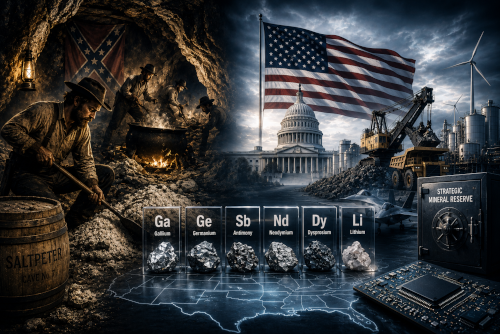
Trump’s Critical Mineral Reckoning
Today, three separate dynamics just collided in our reliance on critical minerals.
Some of you might remember at the end of 2024, when China’s Ministry of Commerce issued Announcement No. 46.
It was a short and blunt (not to mention unprecedented) proclamation that banned the export of gallium, germanium, antimony, and certain superhard materials to the United States.
Prices immediately reacted, with Gallium spot prices running from roughly $940 per kg at the start of 2025 to over $2,100/kg by early 2026 — a 123% move.
Germanium prices tripled, and antimony jumped more than 400%.
Meanwhile, defense contractors activated emergency procurement protocols as semiconductor lines slowed.
By April 2025, Beijing had extended the licensing regime to seven heavy rare earth elements: samarium, gadolinium, terbium, dysprosium, lutetium, scandium, and yttrium.
Then in October, the controls reached lithium battery materials and rare-earth processing technologies.
The Trump-Xi meeting that took place last November produced a one-year suspension of the bans.
Unfortunately, the damage was done.
You see, six months is more than enough time to teach every Fortune 500 supply-chain executive in this country that procurement dependence on a geopolitical adversary isn’t cost-effective. It’s a strategic vulnerability that gets exploited the moment the political weather turns.
Then came Washington’s response.
Earlier this year, President Trump walked into the Oval Office with Cabinet secretaries and executives from GM, GE Vernova, Boeing, and Western Digital.
That’s when he announced Project Vault — a roughly $12 billion strategic reserve for the 60 critical minerals that were on the USGS’ list.
The financing structure mattered, too.
Roughly $10 billion came from the Export-Import Bank (EXIM) — the largest single loan in the agency’s 90-year history, and another $2 billion came from private capital.
The reserve is structured as an independently governed public-private partnership designed to buy minerals when prices are soft, stockpile them domestically, and sell to U.S. manufacturers when the next crisis hits and prices spike.
EXIM Chairman John Jovanovic told the room that the American taxpayer would earn a return on the financing — not subsidize it!
But Project Vault doesn’t sit alone.
The Export-Import Bank has already issued $14.8 billion in Letters of Interest for critical minerals projects under this administration.
Breaking that down a little, we’ll see that approximately $455 million for rare-earth development and processing inside the U.S., another $400 million was slated for lithium extraction in Arkansas, as well as $350 million for cobalt and nickel production in Australia, and $215 million dedicated for tin extraction in the UK and Australia.
This is the most serious U.S. industrial-policy commitment to mineral independence since the Strategic and Critical Materials Stock Piling Act of 1946.
Then came the West Texas convergence.
A few months ago, USA Rare Earth agreed to acquire Texas Mineral Resources Corp. for roughly $73 million in stock. The deal consolidates 100% ownership of the Round Top Project — a billion-ton deposit in Hudspeth County, Texas. It holds fifteen of the seventeen rare earth elements, including the heavy rare earths China dominates almost completely.
A week later, Texas Governor Greg Abbott handed USA Rare Earth a $14.2 million grant from the Texas Semiconductor Innovation Fund.
But USA Rare Earth isn’t just a miner. They own Less Common Metals, one of the world’s leading rare-earth alloy producers, and are building magnet manufacturing capacity in Stillwater, Oklahoma.
In fact, they even control the Pela Ema mine in Brazil and their Accelerated Mining Plan targets commercial production by 2028, scaling to 40,000 metric tons per day by 2030.
The technical term for what they’re building is mine-to-magnet integration, but the political term is the answer to the question Project Vault was created to ask.
Now here’s the part that the investment herd still hasn’t priced in…
Most of Wall Street files rare earths under “speculative China trade.”
It’s a niche that spikes when prices move and collapses when they don’t. The desks tracking semiconductor supply chains aren’t talking to the desks tracking energy and mining.
Meanwhile, their energy desks aren’t modeling what happens when a $12 billion government customer with no domestic alternative starts writing purchase orders to the small handful of North American projects that can actually deliver heavy rare earths at scale.
But we are.
You see, my readers and I have been positioning ourselves well ahead of this realization, well before Round Top crossed the wire in March.
Now the test case has arrived, and that list fits on a single sheet of paper. Round Top is on it, as are a handful of other names most of the herd hasn’t put on the map yet.
The South lost a war because it had no domestic stockpile of one critical mineral on the day it needed one; the U.S. just spent $12 billion making sure that mistake doesn’t get repeated.
And the companies sitting at the intersection of government demand and verified domestic supply are not going to stay this cheap.
Perhaps it’s time you take a peek behind the curtain and learn some of those players for yourself.
Until next time,

Keith Kohl
 Check us out on YouTube!
A true insider in the technology and energy markets, Keith’s research has helped everyday investors capitalize from the rapid adoption of new technology trends and energy transitions. Keith connects with hundreds of thousands of readers as the Managing Editor of Energy & Capital, as well as the investment director of Angel Publishing’s Energy Investor and Technology and Opportunity.
For nearly two decades, Keith has been providing in-depth coverage of the hottest investment trends before they go mainstream — from the shale oil and gas boom in the United States to the red-hot EV revolution currently underway. Keith and his readers have banked hundreds of winning trades on the 5G rollout and on key advancements in robotics and AI technology.
Keith’s keen trading acumen and investment research also extend all the way into the complex biotech sector, where he and his readers take advantage of the newest and most groundbreaking medical therapies being developed by nearly 1,000 biotech companies. His network includes hundreds of experts, from M.D.s and Ph.D.s to lab scientists grinding out the latest medical technology and treatments. You can join his vast investment community and target the most profitable biotech stocks in Keith’s Topline Trader advisory newsletter.


