

Back in 1914, Germany made a huge mistake going to war against the world while being entirely dependent on one substance it had no control over.
Nitrate.
At the time, the Germans were importing practically all of its natural saltpeter almost exclusively from Chile. And if you’ve never heard of nitrate before or what it’s used for, it was essential for both fertilizer and explosives.
Without it, German industry couldn’t feed its people or keep their guns firing.
And you know what? Britain’s navy understood that too.
Within months, the Royal Navy cut off those vital shipping lanes.
If you run the numbers, that blockade should’ve left Germany without gunpowder AND food within a year.
But it didn’t.
You see, a German chemist named Fritz Haber had already figured out how to pull nitrogen straight out of the air itself. This made Chilean nitrate (and the blockade built to choke it off) irrelevant almost overnight.
In this situation, chemistry beats geography.
Today, someone’s trying that same trick again — with the same element, nitrogen.
However, this time it’s a different monopoly, and a very different empire on the other end of it.
Have you guessed who yet?
You know as well as I do that China’s rare earth dominance has looked unbeatable for a decade — roughly 90% of the world’s magnet supply chain.
That’s a chokehold nobody could out-mine or out-spend.
Yet, a small company in Minnesota just got $150 million to make the whole fight irrelevant.
Not by mining more. Not by refining faster.
But by making the whole fight irrelevant.
Although this wasn’t the headline deal from President Trump’s critical minerals roundtable at the State Department on Friday.
But it might be the most important one.
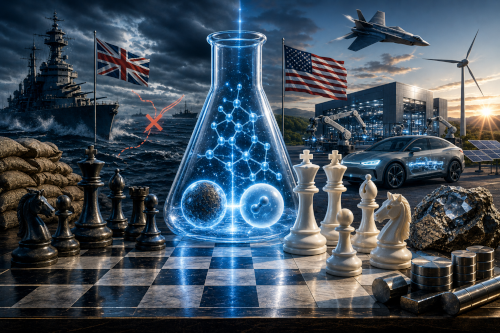
Right now, Niron Magnetics builds permanent magnets out of iron nitride.
That’s iron and nitrogen, two of the most common elements on the planet, sitting under practically every square mile of ground on Earth.
More importantly, nobody controls it.
Compare that to what goes into a traditional rare earth magnet — neodymium, samarium, dysprosium… the elements China has spent the better part of thirty years cornering, from mining to refinery to finished product.
You see, a monopoly built on scarcity only has one real weakness. It can’t defend against a competitor who simply doesn’t need the scarce thing at all.
That’s China’s Achilles’ heel.
And it’s exactly where this $150 million check landed.
The Best Free Investment You’ll Ever Make
Join Gold World today for FREE. Get the latest insight on gold, silver, and precious metals delivered straight to your inbox. When you become a member today, you’ll get our latest free report: “The #1 Golden Token to Buy Now.” Don’t Delay!
After getting your report, you’ll begin receiving the Gold World e-Letter, delivered to your inbox daily.
For a moment, I want you to think about every other critical minerals story we’ve talked about this year.
Whether it’s MP Materials digging and refining rare earths domestically, Trump’s executive command tightening waivers for Chinese-sourced defense materials, or even his export ban locking up scrap tungsten and battery metals.
Every single one of those is a frontal assault against China’s rare earth dominance; a race to control the same scarce inputs China already dominates, just faster and closer to home.
But Niron isn’t a race, it’s a flanking maneuver.
If iron nitride magnets scale — in EVs, wind turbines, defense systems, robotics — they don’t just add a new competitor to the rare earth magnet market. They shrink the size of the market China controls in the first place. So, demand disappears from the very chokepoint everyone else is racing to fix.
And the part that proves to us that Washington isn’t treating it like a school science project is the sheer mountain of cash flowing out of government coffers, such as the $150 million came through the Pentagon’s Office of Strategic Capital.
For the record, this is the exact same mechanism behind the MP Materials deal.
It turns out that Trump isn’t just going for a frontal assault anymore.
But let’s not mistake this for a brand-new idea that showed up out of nowhere…
Remember, iron nitride magnets have been a subject of academic research for decades. Sure, the physics were promising, but nobody could figure out how to manufacture the material at any real scale.
That’s the unglamorous, unsexy work Niron spent years grinding through in order to turn a laboratory curiosity into something you can actually build a factory around.
And that’s precisely the kind of bet that rarely gets attention early.
It doesn’t come with a ribbon-cutting ceremony, either, just a quiet chemistry and manufacturing process solved in a lab in Minnesota, years before anyone in Washington was willing to write a check for it.
However, that check finally came.
Once a workaround like this clears the manufacturing hurdle, it won’t stay a mere curiosity for long, too.
Now step back and look at the bigger picture.
Advancing Our Critical Minerals Flank
Look, the part that snags our attention isn’t Niron being an isolated moonshot bet, but rather one piece of a campaign that’s been accelerating all year, wave after wave, with real cash backing it every step of the way.
Think about how much ground has been covered since January…
We’ve pushed for a multi-billion-dollar strategic minerals stockpile, saw Trump ink an executive order forcing defense contractors off Chinese sourcing (with a hard deadline set in stone), and a one-year export ban locking domestic scrap material inside U.S. borders.
In fact, we’ve even got AI-driven mapping flights hunting for deposits nobody’s found yet!
And then last week, more than $2 billion in fresh commitments spanning batteries, scandium, graphite, tantalum, niobium, and rare-earth-free magnets.
This White House has made one thing unmistakably clear — domestic critical
Nobody seems to be waiting around for permission, either. Some domestic players already have their government backing secured, while others inked new offtake agreements that lock-in buyers before their first shipment leaves the ground.
Of course, this is beginning to expand beyond White House initiatives.
The smart money is already getting familiar with this space while this domestic push is accelerating — before the easy money is gone.
You just need to watch where it lands next.
Until next time,

Keith Kohl
 Check us out on YouTube!
A true insider in the technology and energy markets, Keith’s research has helped everyday investors capitalize from the rapid adoption of new technology trends and energy transitions. Keith connects with hundreds of thousands of readers as the Managing Editor of Energy & Capital, as well as the investment director of Angel Publishing’s Energy Investor and Technology and Opportunity.
For nearly two decades, Keith has been providing in-depth coverage of the hottest investment trends before they go mainstream — from the shale oil and gas boom in the United States to the red-hot EV revolution currently underway. Keith and his readers have banked hundreds of winning trades on the 5G rollout and on key advancements in robotics and AI technology.
Keith’s keen trading acumen and investment research also extend all the way into the complex biotech sector, where he and his readers take advantage of the newest and most groundbreaking medical therapies being developed by nearly 1,000 biotech companies. His network includes hundreds of experts, from M.D.s and Ph.D.s to lab scientists grinding out the latest medical technology and treatments. You can join his vast investment community and target the most profitable biotech stocks in Keith’s Topline Trader advisory newsletter.


