

4 weeks.
That’s the quiet part President Trump inadvertently said out loud a couple days ago.
In fact, his remarks on Wednesday regarding the signed Memorandum of Understanding peeled back the curtain of reality behind the oil crisis that we’ve been talking about for months.
During his speech, President Trump noted:
“If we didn’t do this deal, we could’ve dropped more bombs for another three weeks, two weeks, four weeks, two years… You would never have the Hormuz Strait open… Your market would have, instead of going up, would go down at levels that nobody ever saw before, maybe except for 1929.”
So, it appears he capitulated to avoid an economic catastrophe.
But it was more than just economic ruin that he was worried about.
You see, President Trump also mentioned that we were about four weeks from running out of oil reserves all over the world.
Well, so much for letting the cat out of the bag.
As it stands now, U.S. commercial crude oil inventories are currently 6% below the five-year average; storage at the key hub in Cushing, OK, is at 20 million barrels — very close to the operational minimums.
I guess it only took back to back (to back to back) record draws on our crude stockpiles for someone to finally whisper in Trump’s ear that we might be in trouble. And make no mistake, that puts all the cards in Iran’s hands during these new negotiations.
However, have you seen the other catch yet in this MOU? This isn’t a concrete peace deal, just two sides agreeing to talk about a peace deal.
For 60 days only — just two months for something to go wrong.
At least, that’s the timeframe guarantee for toll-free passages through the Strait of Hormuz.
Once we hit August 18th, Iran will “conduct dialogue” with Oman to “define the future administration and maritime services” in the Strait.
Translation: Get ready to shell out some cash for every oil cargo you want to ship.
Iran’s own state media even confirmed as much, with reports stating that Iran will “begin charging ships for services after that period.”
The country has already set up the Persian Gulf Strait Authority, so the framework is there and the infrastructure is ready.
We’ve moved past a hypothetical negotiation.
It’s a countdown.
The Trump administration is claiming other Gulf states “will never agree to an arrangement that doesn’t permit toll-free access.” But that’s not how leverage works. Iran proved over four months that it can close the Strait and cripple the global economy. Every Gulf state knows Iran can do it again. Every shipping company knows it too.
The market is celebrating a solution, but the maritime industry is waiting for the other shoe to drop.
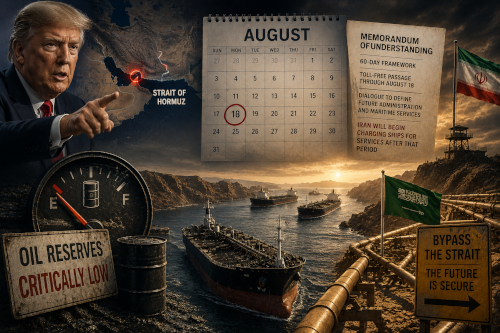
The 60-Day Oil Time Bomb
Look, the narrative now is pretty simple — the strait reopens, supply flows, inventory fills, crisis ends, prices normalize.
But the reality is going to be messier.
Mines still haven’t been cleared from the Strait, and the MOU says Iran will clear them “within 30 days.”
Do you think marine traffic will normalize to pre-war levels with these in place? Yeah, me neither.
That doesn’t mention the fact that Iran controls the timeline for this.
The Best Free Investment You’ll Ever Make
Our analysts have traveled the world over, dedicated to finding the best and most profitable investments in the global energy markets. All you have to do to join our Energy and Capital investment community is sign up for the daily newsletter below.
If de-mining operations slow down — for any reason, or no reason at all — tankers stay stranded. One mine incident and the entire clearance operation gets suspended and the Strait closes again… and we’re back to square one.
I don’t see ship captains (or insurance companies, for that matter) betting their mulit-million dollar tankers on optimistic assumptions; they’ve watched what Iran is willing to do by weaponizing the Strait.
They’ll be waiting for more certainty, which at the earliest doesn’t come until mid-August.
That means inventory drawdowns continue, and storage remains tight.
Together, Saudi Arabia and the UAE cut production by 11 million barrels per day when the Strait was fully locked down. Ramping up those flows will take time, and more important than the oil tankers heading out of the Strait will be how many head in!
Of course, building the infrastructure to bypass the Strait will take until next year at the least.
Too many things can go wrong.
And if even one of them does, the entire narrative collapses.
Welcome to the New Oil Order
Perhaps the most unbelievable headline out there is the IEA’s warning that we’re going to see a massive supply glut in 2027.
Why the market is pricing in that narrative now feels a little too optimistic, but hey — anything to cause crude prices to plummet, right?
The problem is that the IEA is assuming that normalcy returns to global oil markets, and completely ignores what’s actually happened over the last four months.
Oil markets USED TO be driven by supply/demand fundamentals.
OPEC had leverage because they controlled production. Cost curves determined supply responses. Geopolitical risk was priced in, but it was predictable. In other words, analysts knew where the risks were and how they’d resolve.
That’s completely gone now.
And Iran just proved that it can close the world’s most critical oil chokepoint and the global economy can’t stop it for four months. They just proved they have leverage that transcends production levels, cost curves, and traditional OPEC dynamics.
Nobody will ever question whether or not Iran can hold the world’s energy markets hostage, even in the face of the might of the U.S. military, and having a navy we’re told is operating at the bottom of the sea.
Every major oil producer in the Gulf watched this.
It’s why every major player like Saudi Arabia is now making plans to bypass that vital chokepoint forever.
Soon, they’ll have options to get their crude to market — a Saudi pipeline project to bypass the Strait is already breaking ground.
Global oil markets have changed forever.
The sooner the market realizes this, the better.
Until next time,

Keith Kohl
 Check us out on YouTube!
A true insider in the technology and energy markets, Keith’s research has helped everyday investors capitalize from the rapid adoption of new technology trends and energy transitions. Keith connects with hundreds of thousands of readers as the Managing Editor of Energy & Capital, as well as the investment director of Angel Publishing’s Energy Investor and Technology and Opportunity.
For nearly two decades, Keith has been providing in-depth coverage of the hottest investment trends before they go mainstream — from the shale oil and gas boom in the United States to the red-hot EV revolution currently underway. Keith and his readers have banked hundreds of winning trades on the 5G rollout and on key advancements in robotics and AI technology.
Keith’s keen trading acumen and investment research also extend all the way into the complex biotech sector, where he and his readers take advantage of the newest and most groundbreaking medical therapies being developed by nearly 1,000 biotech companies. His network includes hundreds of experts, from M.D.s and Ph.D.s to lab scientists grinding out the latest medical technology and treatments. You can join his vast investment community and target the most profitable biotech stocks in Keith’s Topline Trader advisory newsletter.


