

If you find a 1943 penny that sticks to a magnet, hang on to it.
Not because it’s particularly valuable, mind you, or that they’re worth a few bucks to coin collectors.
You want it because of WHY it exists.
You see, the U.S. Mint actually stopped making copper pennies back in 1943. For exactly one year, our pennies were stamped from zinc-coated steel.
The reason why was pretty simple, too. The U.S. needed every pound of copper it could get its hands on. They needed that copper for things like shell casings and radio components, as well as the miles of electrical wire running through every warship, aircraft, and field communication system rolling off the assembly line.
Copper was too strategically important to waste on pocket change.
Let’s call it a national emergency disguised as a novelty coin.
Today, we’re not rationing copper like we did back then — but maybe we should.
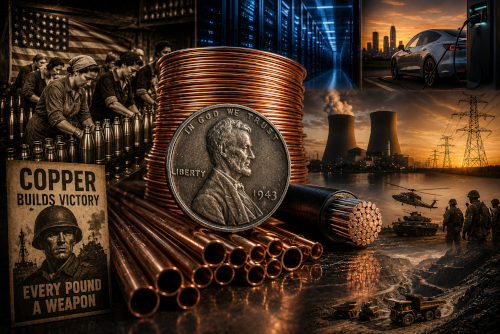
Five Demand Drivers, One Metal.
Let’s be clear here, every single macro investment story for the last few years runs on copper.
We’re talking about AI data centers, electric vehicles, nuclear power, any project trying to modernize our grid. Not to mention the sheer amount of defense spending that’s being spent.
Each one is a copper story under the covers, and they’re all hitting simultaneously.
Of course, the most recent, fastest demand driver revolves around data centers. Keep in mind that these AI-oriented facilities use between 30 and 47 tonnes of copper per megawatt of IT capacity — and that’s just inside the building, too!
The Best Free Investment You’ll Ever Make
Join Gold World today for FREE. Get the latest insight on gold, silver, and precious metals delivered straight to your inbox. When you become a member today, you’ll get our latest free report: “The #1 Golden Token to Buy Now.” Don’t Delay!
After getting your report, you’ll begin receiving the Gold World e-Letter, delivered to your inbox daily.
Usually lost in the conversation are the critical substations and transmission lines feeding them power, as well as the grid upgrades that are necessary. Taking all of this into account, that figure suddenly jumps to 100–150 tonnes per megawatt.
Our data centers’ power demand went from 31 gigawatts last year to 41 gigawatts in 2026 — 10 new gigawatts in a single year.
If we’re looking at about conservative estimates, that’s about 300,000 tonnes of new copper demand from U.S. data centers alone.
In a single year, JP Morgan puts the AI-driven copper demand increment at 110,000 additional tonnes above the pre-AI baseline for 2026, with peak AI copper demand hitting roughly 572,000 tonnes by 2028.
Now add to that mix the push for EVs (which just so happen to contain up to four times the amount of copper as a conventional ICE vehicle), the nuclear buildout, $100 billion in grid infrastructure NERC says is needed by 2033, and defense procurement.
In fact, a study back in January specifically flagged AI and defense spending as the two greatest forces widening the copper supply gap beyond prior projections.
In total, we’re looking at an estimated 2026 global deficit of more than 400,000 tonnes.
And by 2040, current projections call for a cumulative supply shortfall of 10 million metric tons — demand running 50% above current levels with nowhere near enough new supply to meet it.
Copper’s Mining Problem
What’s the concern here?
Well, we know that a new copper mine takes 15 to 20 years from discovery to first production. So as you can expect, the mines that should have been meeting 2026 demand were supposed to be greenlighted around 2008 or 2010.
Unfortunately, many of them weren’t.
You simply can’t compress that timeline any more than you can rush a clinical trial.
Meanwhile, the mines that exist are running into trouble.
I know the veteran members of our investment community remember what happened last year to Freeport-McMoRan’s Grasberg operation in Indonesia — one of the largest copper mines on Earth.
Tragically, it was hit by a mud rush incident in September 2025 and forced Freeport to suspend operations. The projected copper loss from Grasberg alone was 600,000 metric tons by the end of 2026.
To put a little perspective on that number, it exceeds the entire projected 2026 global deficit!
Folks, that’s just one incident at one mine.
In South America, where roughly 40% of the world’s mined copper comes from, production is grinding lower.
Freeport’s Cerro Verde operation in Peru produced 863 million pounds of copper in 2024 — down from 949 million the year before. Meanwhile, the El Abra mine in Chile submitted an environmental impact statement for a major expansion in March 2026, and that EIS review (plus construction) puts meaningful new output years away.
Yet, the demand side can respond in 24 months. Remember, a new AI data center goes from announcement to operational faster than that.
Although new supply takes 20 years, the market just doesn’t care about pesky little timelines.
Eighty years ago, the U.S. government pulled copper from pocket change because the country needed it for something more important.
Today, nobody’s going to ask you to turn in your pennies, but you can bet those demand drivers are firing on all cylinders while new supply needs decades to meaningfully respond.
That’s the opportunity we crave, with copper critically interwoven through every major theme in energy and technology right now.
Until next time,

Keith Kohl
 Check us out on YouTube!
A true insider in the technology and energy markets, Keith’s research has helped everyday investors capitalize from the rapid adoption of new technology trends and energy transitions. Keith connects with hundreds of thousands of readers as the Managing Editor of Energy & Capital, as well as the investment director of Angel Publishing’s Energy Investor and Technology and Opportunity.
For nearly two decades, Keith has been providing in-depth coverage of the hottest investment trends before they go mainstream — from the shale oil and gas boom in the United States to the red-hot EV revolution currently underway. Keith and his readers have banked hundreds of winning trades on the 5G rollout and on key advancements in robotics and AI technology.
Keith’s keen trading acumen and investment research also extend all the way into the complex biotech sector, where he and his readers take advantage of the newest and most groundbreaking medical therapies being developed by nearly 1,000 biotech companies. His network includes hundreds of experts, from M.D.s and Ph.D.s to lab scientists grinding out the latest medical technology and treatments. You can join his vast investment community and target the most profitable biotech stocks in Keith’s Topline Trader advisory newsletter.


