

Just about 144 years ago, Thomas Edison threw a switch in a brick building on Pearl Street in lower Manhattan and changed the trajectory of our society forever.
The moment the switch flicked on, roughly 85 customers — including the editors of The New York Times — experienced electric light for the first time.
Yet, it took the entire continental United States a full year to wire what Edison built in that one neighborhood.
We’re talking miles and miles of copper wire running beneath the streets. You see, copper was so expensive that Edison redesigned his entire system twice just to reduce how much of it he needed.
Today, we’re living through an all-too familiar story.
Just think, a single hyperscale AI data center requires more copper than what Edison needed to run through his entire Manhattan grid.
Except, we’re not building one of them… we’re going to build thousands.
Each one pulling power around the clock without so much as a cigarette break.
And you know what? Not only has Wall Street not priced this in yet, but the sobering truth is that the copper doesn’t exist.
Not yet.
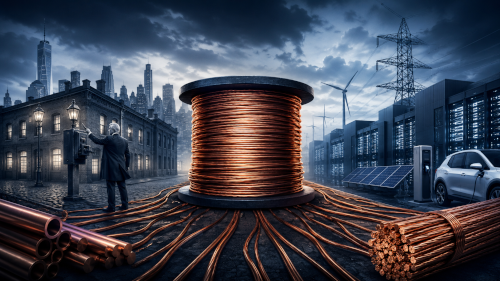
You know just as well as I do that Big Tech has opened the capital floodgates to sustain this AI boom.
Last year, they shelled out nearly $400 billion.
However, that number is climbing another 50-75% in 2026 — and we’re looking at $600 to $725 billion in spending from Amazon, Google, Meta, and Microsoft alone.
Keep in mind that every server rack, cooling tower, transformer, and mile of electrical busbar inside those buildings runs on copper.
The Best Free Investment You’ll Ever Make
Our analysts have traveled the world over, dedicated to finding the best and most profitable investments in the global energy markets. All you have to do to join our Energy and Capital investment community is sign up for the daily newsletter below.
Look, a modern hyperscale data center requires a staggering amount — between 1,800 and 2,500 tons — of copper just to build and wire.
However, that’s also before you account for the transmission infrastructure connecting the facility to the grid.
And before you account for the solar farms and wind turbines generating the electricity that powers it, or even the growing number of EVs that’ll be on our roads, too.
We know that data centers now account for roughly half of all new U.S. electricity demand growth!
And yet, nobody’s asking the obvious question: where does the copper actually come from?
The entire AI infrastructure buildout — along with ALL of the energy systems being erected to power it — share exactly one bottleneck.
It isn’t silicon, and it won’t be lithium.
It’s copper.
So here’s where it gets interesting…
Global copper mine production in 2025 was roughly 23 million metric tons.
However, global demand right now is upwards of 28 million metric tons.
Folks, we’re already running a deficit.
Things get worse, too.
S&P Global projects that by 2040, copper demand will explode to 42 million metric tons — a 50% increase from current levels.
Again, that growth will be driven by electrification, AI data centers, electric vehicles, renewable energy infrastructure, and defense spending accelerating simultaneously.
What will the current mine development pipeline actually deliver by 2040?
The answer is closer to 22 million metric tons… MAYBE 27 million if production peaks in 2030 as some estimates suggest.
Then it declines.
That’s a gap as wide as 20 million metric tons, or a 30-50% shortfall against a commodity that runs everything.
And here’s why it doesn’t close fast…
You see, the average copper deposit takes 10 to 15 years from discovery to first commercial production.
Ore grades across existing mines are declining as capital costs rise. Meanwhile, permitting timelines move at the speed of molasses.
That’s not to mention the fact that China controls 40% of global smelting capacity and is consolidating more.
In other words, the copper supply chain is broken before it even gets to the factories.
Now here’s the catch…
We’ve been here before.
Back in 1973, the U.S. imported 100% of its chromium, 98% of its manganese, 91% of its cobalt.
We learned a brutal lesson that year about import dependency on industrial metals. Then promptly forgot it the moment the crisis passed.
This is the same story, just cut and paste in a different commodity and demand driver.
That’s why $128 billion dollars flooded into critical minerals extraction and processing in 2025, which is up 62% in two years.
That’s pretty impressive on paper, but copper deposits don’t respond to capital the way a shale well does — you can’t drill a copper mine into production in a short period of time.
You can bet the market will catch up to this.
It always does.
We know that all copper plays aren’t exactly created equal.
Freeport-McMoRan produces approximately 4.2 billion pounds of copper annually — a scale no competitor gets close to matching.
When the copper market tightens, the institutional crowd moves into the big names first — Freeport is that name.
Southern Copper, on the other hand, sits on a reserve base approaching one billion metric tons with all-in sustaining costs among the lowest in the industry.
And then there’s Ivanhoe Mines’ Kamoa-Kakula operation in the DRC, which sits on one of the highest-grade large-scale copper deposits ever found; grade translates directly into lower costs and faster ramp times.
Wall Street hasn’t fully repriced what that deposit is worth in a supply-constrained decade.
But copper is just one thread in a much bigger story.
Edison spent more on copper wiring than anything else in the Pearl Street project.
A century later, we’re about to make that look like a rounding error.
P.S. The World’s No. 2 Gold Miner Is Running Out of Gold
The world’s No. 2 gold miner just announced it’s breaking itself apart, and it’s not because business is booming. Barrick’s reserves are drying up, Newmont’s are shrinking, and the majors are now spending billions gobbling up junior miners to replace what’s vanishing underground. Three small gold stocks trading under $5 own exactly the ground these desperate giants need next.
Until next time,

Keith Kohl
 Check us out on YouTube!
A true insider in the technology and energy markets, Keith’s research has helped everyday investors capitalize from the rapid adoption of new technology trends and energy transitions. Keith connects with hundreds of thousands of readers as the Managing Editor of Energy & Capital, as well as the investment director of Angel Publishing’s Energy Investor and Technology and Opportunity.
For nearly two decades, Keith has been providing in-depth coverage of the hottest investment trends before they go mainstream — from the shale oil and gas boom in the United States to the red-hot EV revolution currently underway. Keith and his readers have banked hundreds of winning trades on the 5G rollout and on key advancements in robotics and AI technology.
Keith’s keen trading acumen and investment research also extend all the way into the complex biotech sector, where he and his readers take advantage of the newest and most groundbreaking medical therapies being developed by nearly 1,000 biotech companies. His network includes hundreds of experts, from M.D.s and Ph.D.s to lab scientists grinding out the latest medical technology and treatments. You can join his vast investment community and target the most profitable biotech stocks in Keith’s Topline Trader advisory newsletter.


