

Back in May 1796, a country doctor named Edward Jenner scraped pus from a sore on a milkmaid’s hand and injected it into an eight-year-old boy named James Phipps.
You see, Jenner had noticed something odd. He noticed that milkmaids who caught cowpox — a mild disease that scarred you up but rarely killed you — never seemed to catch smallpox.
And if you weren’t aware, smallpox was THE killer back then.
Roughly one in ten Brits died from it, and Jenner had no idea why the pattern held… he just knew it did.
So, he tested it.
Then six weeks later, Jenner exposed Phipps to live smallpox, and the boy never got sick.
Folks, that single, lucky observation became the first vaccine in human history.
And it took 180 more years of trial, error, and dead ends before the World Health Organization finally declared smallpox eradicated in 1980.
One lucky observation and 200 years of grinding research.
Last month, a team at Cambridge just skipped the luck entirely.
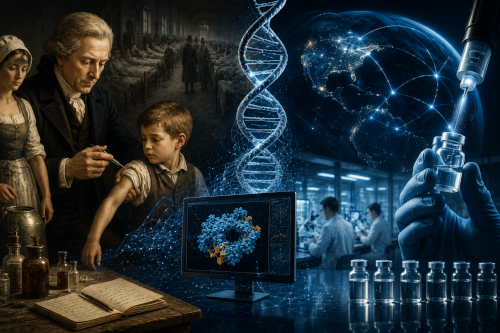
Recently, Cambridge and its spinout DIOSynVax just dosed the first human volunteers with a vaccine whose active ingredient was never observed in nature.
But they weren’t copying anything, and it wasn’t optimized from an existing design. Rather, it was built from scratch by an AI system that scanned genetic surveillance data across the entire Sarbecovirus family — SARS-CoV-2, SARS, and a handful of bat coronaviruses that have never even infected a human — and stitched their shared vulnerabilities into a single synthetic super-antigen.
There weren’t any milkmaids around, nor were there any lucky sores in sight. In fact, they didn’t even waste 20 years of animal testing before anyone risked putting it in a human.
During the first phase of the trial, about 39 healthy volunteers were used, each receiving their down needle-free through a micro-fluid jet.
When the results came back clean, safe, and well tolerated, they knew they were on to something by generating immune responses against viruses the human body has never encountered.
The Best Free Investment You’ll Ever Make
Our analysts have traveled the world over, dedicated to finding the best and most profitable investments in the global energy markets. All you have to do to join our Energy and Capital investment community is sign up for the daily newsletter below.
For the record, it was the first time a vaccine’s core ingredient was built entirely inside a computer before it ever touched a lab bench.
And it’s not alone.
A little over a week later, Absci reported positive Phase 1 data on ABS-201 — an antibody targeting the prolactin receptor.
But what makes it different from every antibody drug that’s ever been made is the fact that Absci’s AI didn’t take an existing antibody and tweaked it.
Instead, it designed one from scratch, and 32 healthy adults dosed up to 1,800 milligrams with no serious adverse events.
The next data readout is already on the calendar for later this year.
They’re not alone, either.
Generate Biomedicines ran the same playbook on a COVID-neutralizing antibody called GB-0669 and saw positive Phase 1 results with no dose-limiting toxicities.
And here’s where things get interesting…
You know as well as I do that traditional biologic development runs 10 to 15 years — let’s call it 120 to 180 months.
So, we’re talking about a process 91% faster than how things are normally done.
This is different from the AI drug story I’ve told before — the one where algorithms sift through billions of small-molecule compounds looking for the needle in a 10⁶⁰-possibility haystack.
That’s AI as a faster search engine.
What’s happening here is AI as an author, creating biological structures that never existed anywhere in nature, with no template to copy from at all.
Wall Street’s Search Has Begun
Today, the monoclonal antibody market sits at roughly $322 billion in 2026.
By 2035, it’s on a path to hit $936 billion — strong growth in an area that AI just learned to write from scratch.
Moreover, biologics made up about 32% of the FDA’s novel drug approvals in 2024. By 2030, that number is projected to climb to 60%.
That means the entire center of gravity in pharmaceutical development is physically moving toward the category these AI-designed drugs represent.
But no matter how a drug is designed, it still has to clear the same gauntlet: Phase 1 safety data, proof-of-concept readouts, FDA decisions — these are all dated events put on a calendar, not a whisper mill.
These events can routinely send biotech stocks soaring in a single session, too.
Absci’s next readout is one of those dates, and so is whatever Generate or the next AI-native biologics company rolls out.
We’re past this being a mere market side note, we’re talking about the entire game in this corner of the market.
Of course, the companies building AI-designed drugs tend to steal the headlines, with too few investors fully taking advantage of the situation.
Jenner didn’t understand immunology, he simply recognized a pattern before anyone else and acted on it.
The pattern today is easier to see than you might believe.
Perhaps it’s time you take a look for yourself.
Until next time,

Keith Kohl
 Check us out on YouTube!
A true insider in the technology and energy markets, Keith’s research has helped everyday investors capitalize from the rapid adoption of new technology trends and energy transitions. Keith connects with hundreds of thousands of readers as the Managing Editor of Energy & Capital, as well as the investment director of Angel Publishing’s Energy Investor and Technology and Opportunity.
For nearly two decades, Keith has been providing in-depth coverage of the hottest investment trends before they go mainstream — from the shale oil and gas boom in the United States to the red-hot EV revolution currently underway. Keith and his readers have banked hundreds of winning trades on the 5G rollout and on key advancements in robotics and AI technology.
Keith’s keen trading acumen and investment research also extend all the way into the complex biotech sector, where he and his readers take advantage of the newest and most groundbreaking medical therapies being developed by nearly 1,000 biotech companies. His network includes hundreds of experts, from M.D.s and Ph.D.s to lab scientists grinding out the latest medical technology and treatments. You can join his vast investment community and target the most profitable biotech stocks in Keith’s Topline Trader advisory newsletter.


