

President Trump finally did it.
The meetings are done, and the time for negotiation is over.
He finally put a stopwatch on one major problem we’ve had with China over the years.
But this countdown isn’t some blue-ribbon commission, or is it a decades-long “roadmap” that’ll just be overturned when a new administration comes into town.
A few days ago, President Trump signed a proclamation invoking Section 232 national security authority to “adjust imports” of processed critical minerals and the products made from them.
Then, he gave his trade team exactly 180 days to come back with binding, enforceable agreements that reduce America’s reliance on foreign processing.
That official deadline lands on July 13, 2026.
If that sounds like war planning, good….
That’s the point.
Why?
Well, because the next global chokehold won’t look like an oil embargo. It’ll look like your supply chain is quietly running out of the obscure, critical materials that make modern life work.
Rare earths. Lithium. Nickel. Graphite — all the little rocks and metals that decide whether America can build EVs, jet fighters, drones, robotics, missile systems, and the industrial motors that keep the whole machine moving.
You see, President Trump’s order admits the ugly truth most politicians avoid saying out loud: U.S. miners just aren’t enough… not yet.
For the time-being, he’s holding off on immediate tariffs and instead ordering Commerce and the U.S. Trade Representative to go deal-shopping overseas — lock up supply from friendly countries before someone else does.
It’s a short-term scramble with a long-term motive.
Breaking our shackles to China’s critical minerals.
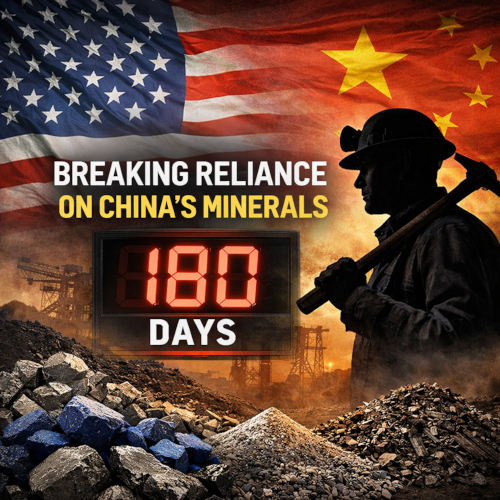
Trump Just Put China On the Clock
Look, the White House didn’t frame this as an environmental initiative or an industrial wish list.
Instead, it came under the national security umbrella.
What it also targets is the processing of critical minerals and their derivative products, which is just a polite way of saying that the problem isn’t just what’s in the ground, it’s also about who controls refinement, too.
Now under Section 232, both the Commerce Secretary and Trade Representative will be negotiating new or expanded agreements with trading partners to “adjust imports” so they don’t threaten to impair national security.
Mind you, this comes with a very explicit 180-day deadline.
However, what makes this different is what Trump didn’t do — at least not yet.
So far, he’s held off on immediate tariffs, choosing negotiations first, with import restrictions still sitting on the table if talks fail.
What we’re looking at is a “buy time” phase.
This allows us to stabilize the supply chain by leaning on allies and alternative sources while the U.S. develops its mining sector by bolstering processing capacity, refining, magnet manufacturing, and the midstream industrial plumbing that never makes headlines until it breaks.
Now Congress is moving in a similar direction, with a bipartisan bill introduced yesterday which would create a $2.5 billion Strategic Resilience Reserve to stockpile minerals like lithium, nickel, and rare earths.
The purpose isn’t just “having a stash” of strategic metals.
We’re talkinga bout price stabililty, too.
The Best Free Investment You’ll Ever Make
Our analysts have traveled the world over, dedicated to finding the best and most profitable investments in the global energy markets. All you have to do to join our Energy and Capital investment community is sign up for the daily newsletter below.
The argument here is pretty simple… China has used its market dominance to flood supply, pressure prices, and make competing mining and refining projects financially unbearable.
But this bill structure is intentionally unusual, implementing a seven-member board modeled after the Federal Reserve, designed to buy, store, and potentially sell minerals for civilian and defense needs.
That’s the real tell, dear reader.
Because when Washington starts aggressively building a stockpile of critical minerals, this isn’t a normal commodity market anymore.
A New Day for U.S. Miners
This is where things stop being a trade story and attracts Wall Street eyeballs.
That’s because we all know that securing critical minerals from our allies is just a temporary bandaid and not a cure.
And Trump’s July deadline is meant to force the first fix: diversify supply now, reduce exposure to a single bottleneck, and keep the industrial machine from stalling.
However, the endgame is — and always will be — boosting our domestic miners. That way, the U.S. can’t be strangled by a policy memo issued on the other side of the planet.
That’s also why the focus keeps snapping back to refining and processing.
Sure, you can mine the material and ship it overseas to be refined, but you’re still relinquishing some of your independence.
And that’s where the opportunity shows itself.
Remember, this buildout of the U.S. mining sector doesn’t start the day the federal government announces it.
No, it starts years earlier, with the companies that already have permits in motion, exploration underway, metallurgy figured out, and real projects advancing while everyone else is still arguing on cable news.
Of course, the most interesting players here aren’t always the ones begging for subsidies.
In fact, the best-positioned U.S. miners are the ones that can fund their future without waiting for Washington to get organized — especially the rare breed that has one foot in critical minerals and the other foot in a veritable cash-flow engine.
Sometimes that engine is something old-fashioned and beautifully useful: Gold.
When gold prices rise, balance sheets fatten, and those critical mineral projects stop being a PowerPoint dream and become a fully funded operation.
Until next time,

Keith Kohl
 Check us out on YouTube!
A true insider in the technology and energy markets, Keith’s research has helped everyday investors capitalize from the rapid adoption of new technology trends and energy transitions. Keith connects with hundreds of thousands of readers as the Managing Editor of Energy & Capital, as well as the investment director of Angel Publishing’s Energy Investor and Technology and Opportunity.
For nearly two decades, Keith has been providing in-depth coverage of the hottest investment trends before they go mainstream — from the shale oil and gas boom in the United States to the red-hot EV revolution currently underway. Keith and his readers have banked hundreds of winning trades on the 5G rollout and on key advancements in robotics and AI technology.
Keith’s keen trading acumen and investment research also extend all the way into the complex biotech sector, where he and his readers take advantage of the newest and most groundbreaking medical therapies being developed by nearly 1,000 biotech companies. His network includes hundreds of experts, from M.D.s and Ph.D.s to lab scientists grinding out the latest medical technology and treatments. You can join his vast investment community and target the most profitable biotech stocks in Keith’s Topline Trader advisory newsletter.


