

Things have gone from bad to worse this week.
Ever since we talked earlier this week about the real driver behind closing that tiny 22-mile-wide narrow strip of the Strait of Hormuz, more than 200 tankers have become effectively stranded.
Remember, Iran doesn’t necessarily need to strike those tankers to throw a wrench into global supply, they just need to strike enough fear into the insurance companies that would have to pay for any damages.
And that, dear reader, is precisely what has happened over the last few days.
Today, the war risk premium has driven WTI crude to $80/bbl, with Brent hitting $85/bbl.
Iran has successfully caused Qatar to declare force majeure and halt LNG production. Their most recent missile strikes extended into Azerbaijan, where more than half a million barrels per day are extracted.
There’s no way to mince words here, the Middle East is on fire.
However, the Saudis do hold a little ace up their sleeve.
Let me introduce you to the East-West oil pipeline, and right now it’s the saving grace for Saudi Arabia’s oil industry.
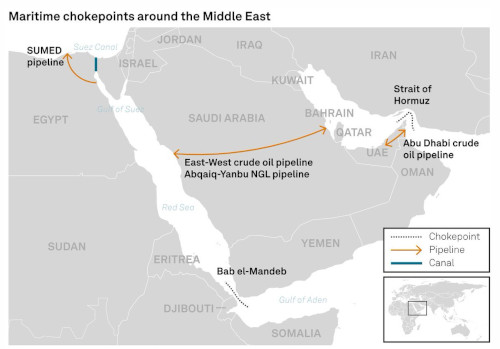
As you can see, the East-West pipeline allows the Saudis to bypass the Strait of Hormuz and get around 7 million barrels per day out the backdoor.
If Iran takes this out, all hell will break loose.
Of course, there’s something else exacerbating the situation. The fact that media headlines have been screaming about a global supply glut (that never materialized) has made things far tighter than we could imagine.
And what’ll come next would be the greatest opportunity oil investors have ever seen before.

The True Secret Driver Behind $100 Oil
You see, this is where the whole “supply glut” narrative comes crashing down.
For the entire year of 2025, the International Energy Agency hammered the same drumbeat: massive oversupply coming, 4 million barrels per day surplus by 2026, prices heading lower, oil demand peaking by 2030.
Wall Street ate it up as investment banks parroted the same line. Meanwhile, the media couldn’t help themselves by amplifying the message until it became gospel.
And we told you it was nonsense.
The IEA’s own numbers kept contradicting their forecasts.
In October 2025, they couldn’t account for 1.47 million barrels per day of oil in their global balances. That’s not a rounding error — that’s a hole big enough to drive a supertanker through.
By December, they quietly trimmed their 2026 surplus forecast from 4.09 million bpd to 3.84 million bbls/d. Then in January, down to 3.69 million bbls/d. Then demand growth estimates jumped from 730,000 bbls/d to 930,000 bbls/d.
Makes sense, right? Every month, the “inevitable glut” got smaller as reality refused to cooperate with the models.
Trust me, this wasn’t careful analysis, but rather a narrative management dressed up as forecasting.
The Best Free Investment You’ll Ever Make
Our analysts have traveled the world over, dedicated to finding the best and most profitable investments in the global energy markets. All you have to do to join our Energy and Capital investment community is sign up for the daily newsletter below.
Now, Iran just exposed how fragile global supply actually is.
Last week’s kick-off of Operation Epic Fury changed the world of geopolitics forever.
How could it not? Not only have they coordinated airstrikes that killed Supreme Leader Ali Khamenei, the NEXT Ayatollah, but they also killed everyone VOTING for a new Supreme Leader… all while decimating Iran’s military infrastructure.
Within hours, Iran’s IRGC warned vessels to avoid the Strait of Hormuz or face attack.
They didn’t need a naval blockade or mines to do it, either.
They used cheap drones to strike three tankers near the strait, and insurance companies immediately pulled coverage. War-risk premiums exploded from 0.125% to 0.4% of ship value per transit — a quarter-million-dollar increase for very large crude carriers.
Then this week, tanker traffic through the Strait of Hormuz dropped by 90%.
Yes, you read that correctly.
Over 200 vessels sat idle in the Persian Gulf, unable to move. Iraq started shutting down production in its largest oil fields because without export routes, there’s nowhere to put the oil.
Again, we saw Qatar declared force majeure and halted LNG production after Iranian strikes hit their facilities. In a heartbeat, natural gas prices in Europe doubled in three days, peaking above €60/MWh before settling around €48/MWh.
But Iran’s missile strikes extended beyond the Gulf.
They hit Dubai, Abu Dhabi, Doha, Kuwait, Bahrain, Saudi Arabia’s Ras Tanura refinery, and — most recently — Azerbaijan, where over 500,000 barrels per day are extracted.
For the record, about 20% of the world’s oil and 25% of global LNG shipments move through the Strait of Hormuz daily. That’s 20 million barrels of oil worth roughly $500 billion in annual energy trade.
Of course, it’s also not to mention other vital commodities to the global economy that are also shut down — such as 33% of fertilizer supply.
Go ahead and take a look at the share of other global commodities that run through the Strait:
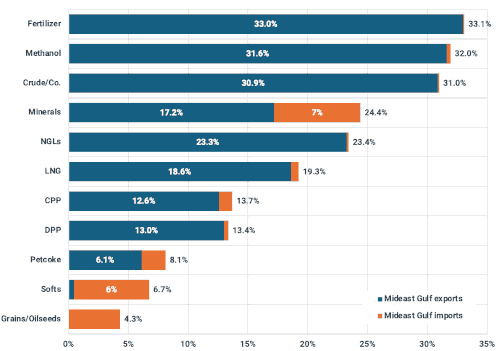
Look, this is the “1970s oil embargo” scenario everyone forgot was possible.
RBC Capital Markets called it the biggest energy crisis since the 1973 embargo. Analysts who spent 2025 predicting oversupply are now forecasting Brent crude hitting $100 per barrel or more if disruptions persist beyond two weeks.
The supply glut was always a mirage propped up by assumptions that nothing would ever go wrong — that Iran wouldn’t close the strait, that Venezuela and Russia would keep pumping despite sanctions, that China would stop stockpiling, that U.S. shale would grow forever.
None of those assumptions survived contact with reality.
Here’s what actually happened: China stockpiled 110 million barrels between April and August 2025, lifting commercial inventories 30% above 2019 levels thanks to a new Energy Law mandating strategic reserves.
The IEA counted that as “oversupply” when it was deliberate preparation for exactly this scenario.
What about U.S. production? The EIA now projects 13.5 million bpd in 2026 — down 100,000 bpd from 2025.
For the record, that’s the first annual decline since 2021, despite all the “shale will save us” cheerleading.
The Permian Basin, which carries U.S. production, is plateauing at 6.6 million bpd. Not crashing, but not growing either. Rig counts dropped 15% from last year’s peak. Breakeven prices sit around $61-62 per barrel, and WTI was trading below that for months before Iran lit the match.
Don’t get me wrong, the IEA was right about one thing: something had to give.
They just got the direction backwards.
The Permian Advantage No One’s Pricing In… Yet
The Middle East is burning, and nobody knows when the smoke clears.
That makes every barrel extracted from U.S. soil exponentially more valuable — not because we’re replacing 20 million barrels per day of Strait of Hormuz capacity, but because domestic supply just became the most reliable on earth.
You see, U.S. production isn’t surging the way most people think.
The EIA projects essentially flat output through 2026 as prices hovered below breakeven for most of 2025. But the Permian Basin remains the crown jewel, accounting for nearly half of total U.S. crude production at 6.6 million bpd.
Here’s what separates winners from everyone else: Efficiency.
The best Permian operators slashed drilling time by 20-50% since 2019.
Meanwhile, the average time from rig to production dropped to 63 days, thanks to longer laterals, better completions, tighter capital discipline — it all translates to lower costs per barrel and faster payback even when prices fluctuate.
Look, this isn’t about wildcatters gambling on exploration.
We’ve moved well beyond that.
Today, it’s about proven operators extracting maximum value from Tier 1 acreage using technology that didn’t exist five years ago.
We’ve found one tiny Permian operator — trading 823 times smaller than Exxon — that’s perfected this model.
While Big Oil pivots to shareholders and buybacks, this company is laser-focused on one thing: efficient Permian production with industry-leading well economics. They’re not trying to be the biggest. They’re trying to be the most profitable per barrel in the most valuable oil basin on the planet.
Trust me, when Middle East supply remains uncertain and U.S. output plateaus, the companies squeezing maximum returns from premium Permian acreage will print money at $80/bbl oil.
Until next time,

Keith Kohl
 Check us out on YouTube!
A true insider in the technology and energy markets, Keith’s research has helped everyday investors capitalize from the rapid adoption of new technology trends and energy transitions. Keith connects with hundreds of thousands of readers as the Managing Editor of Energy & Capital, as well as the investment director of Angel Publishing’s Energy Investor and Technology and Opportunity.
For nearly two decades, Keith has been providing in-depth coverage of the hottest investment trends before they go mainstream — from the shale oil and gas boom in the United States to the red-hot EV revolution currently underway. Keith and his readers have banked hundreds of winning trades on the 5G rollout and on key advancements in robotics and AI technology.
Keith’s keen trading acumen and investment research also extend all the way into the complex biotech sector, where he and his readers take advantage of the newest and most groundbreaking medical therapies being developed by nearly 1,000 biotech companies. His network includes hundreds of experts, from M.D.s and Ph.D.s to lab scientists grinding out the latest medical technology and treatments. You can join his vast investment community and target the most profitable biotech stocks in Keith’s Topline Trader advisory newsletter.


