

In the blink of an eye, the whispers of war had turned into blaring trumpets.
Most believed that all we needed were missile strikes to move the needle on crude, even though the dial barely moved when the U.S. and Israel obliterated Iran’s nuclear sites last summer.
But what it would really take was a direct threat to the physical infrastructure — to the ships, the refineries, the chokepoints.
Well, any hope for a peaceful resolution vanished the moment Operation Epic Fury began.
At 1:15 a.m., all hell broke loose in Tehran as U.S. and Israeli forces launched coordinated strikes on Iran.
The aftermath from this weekend’s devastation was nothing short of game-changing for global geopolitics.
The Ayatollah is dead. The NEXT Ayatollah is dead. Iran’s military command structure was devastated. Within the first 24 hours, U.S. bombers hit more than 1,000 targets.
The moment President Trump started moving his naval pieces into place — at the cost of billions of dollars — the world should’ve realized that this war was a matter of ‘when’, not ‘if’.
And the real unsolved mystery looming over every oil traders’ mind was: How would Iran respond.
It didn’t take long for the worst case scenario to start rearing its ugly head. Iranian missiles rained down on its neighbors in the region —Saudi Arabia, Qatar, UAE, Kuwait, Bahrain, Israel, Iraq… none were spared.
Mind you, Iran’s military targeted more than just U.S. bases.
Trust me, this is the moment we’ve been watching build for months. The question now isn’t whether oil prices spike.
It’s how high — and for how long.
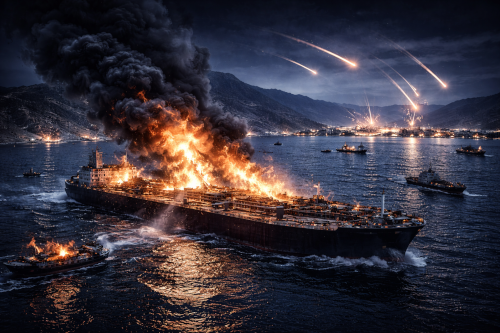
Clearing Up the Oil Myths Behind This War
Perhaps the most popular story flooding every headline was about the Strait of Hormuz.
Keep in mind that Iran threatening tanker traffic in the Strait of Hormuz has become so common, that more than a few of us were left wondering if this was finally the moment they’d stop crying wolf.
Let’s straighten the record here: No, Iran can’t simply close the Strait of Hormuz the way you close a door.
There’s no switch, and no lever for this narrow 22-mile-wide international waterway. To formally close the Strait would be to eliminate every tanker and boat that tries to pass through… not that they aren’t trying.
When Iran’s revolutionary guard declared the Strait of Hormuz was closed to all ships, it wasn’t missiles that slowed tanker traffic — it was insurance forms.
The Best Free Investment You’ll Ever Make
Our analysts have traveled the world over, dedicated to finding the best and most profitable investments in the global energy markets. All you have to do to join our Energy and Capital investment community is sign up for the daily newsletter below.
Steamship Mutual — one of the world’s largest maritime war-risk insurers — issued a formal Notice of Cancellation of War Risks coverage for the Persian Gulf and adjacent waters, effective March 1st.
The Joint Maritime Information Center has elevated the regional threat level to CRITICAL, and without war-risk coverage, no captain in his right mind would sail through such a narrow corridor where Iranian drones struck three U.S.- and UK-flagged tankers in 36 hours.
If you want an idea of how serious they are this time, the first tanker that Iran fired upon was a small sanctioned one that was a part of the “dark fleet” used to smuggle petroleum products under the table.
The tanker was in the wrong place at the wrong time, loaded up Iranian crude and may have decided to make a run for it without paying for it.
By the way, while we’re looking for signs this conflict was inevitable, do you think it was really a coincidence that Iran pre-positioned most of its own tankers out of the Strait weeks ago?
They saw this coming folks…
And now Maersk, Hapag-Lloyd, CMA CGM, and MSC have all suspended operations.
Over 150 tankers — representing roughly 77 million barrels of oil — are sitting anchored in open Gulf waters, going nowhere. That’s about 10 days of global shipments, just floating there in the heat.
Go ahead and take a look for yourself at how tankers were stacking up on either side of that narrow strip of water in the Strait:
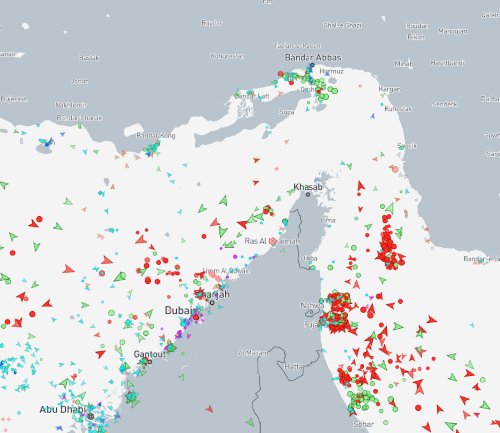
Iran didn’t close the Strait, the insurance market did.
But here’s the thing that should be keeping every oil trader awake right now: the Strait of Hormuz ISN’T actually the worst-case scenario anymore.
The part of Iran’s strategy that shocked everyone was when they started going after its neighbors’ oil and gas infrastructure:
Saudi Arabia’s Ras Tanura refinery: A huge facility that processes 550,000 barrels per day and serves as the loading terminal for the world’s largest oilfield — was struck by Iranian drones this morning. It’s been shut down as a precautionary measure. For the record, that’s the same facility that was targeted in 2019 when Houthi strikes briefly knocked out 5% of global supply and triggered the biggest single-day oil price spike since the Gulf War.
QatarEnergy: Qatar — a top-three LNG exporter that accounts for roughly 20% of global LNG supply — has completely halted production. Iranian drones struck its facilities at Ras Laffan Industrial City. Once that was announced, Dutch gas futures spiked nearly 50% in a single session; Asian LNG prices jumped 39%; European gas markets haven’t seen moves like this in four years.
Iraqi Kurdish oil fields: More than 200,000 barrels per day that flow into Turkey were shut down as a precaution.
Israel’s Leviathan gas field: The $35 billion export expansion has been ordered offline by the Israeli government.
Even a secondary choke point, the Bab el-Mandeb Strait near Yemen, is being avoided by major carriers.
This isn’t a risk premium in the abstract, but rather a real-time supply disruption across the entire Middle Eastern energy complex simultaneously.
And then there’s the true lynch-pin for an oil spike in this conflict — Kharg Island, where explosions were reported over the weekend.
For a little perspective on how vital Kharg Island is to Iran’s oil industry, roughly 90% of Iran’s crude exports flow through here.
If President Trump and his allies decide to finish the job at Kharg, that’s what it would take to see the price shock everyone has been anxious about… if destroyed, $100 per barrel would see a supply shock on top of a supply shock — and the $100 per barrel projections may be conservative.
American Oil Just Became the Most Valuable Commodity on Earth
At the heart of the bullish case for oil isn’t Iranian missiles, by the way, it’s the overhyped supply glut that the media has gotten wrong so far in 2026.
You know as well as I do that for the better part of the last year, the media narrative was drowning in oil oversupply.
OPEC+ was pumping too much. U.S. shale was broken. WTI was grinding through the $60s, dipping into the $50s, and the rig count was bleeding — down 79 rigs from a year ago to just 409 operating today.
Meanwhile, we have some of the biggest names in the U.S. oil industry hitting the brakes on drilling.
Some of you might remember when Harold Hamm told us that Continental Resources was halting drilling in the Bakken for the first time in 30 years.
Or when the Dallas Fed told us operators needed $65 per barrel just to justify a new well.
The market heard all of that and shrugged.
Well, the market is done shrugging.
That’s the part most people should be processing this morning.
Why?
Well, because the cold, bitter truth is that the oversupply crowd conveniently ignored one small little thing — the world’s so-called spare capacity lives almost entirely in the Gulf states… Saudi Arabia, UAE, Iraq, Kuwait.
They’re now the same countries currently absorbing Iranian missile strikes, and the same countries whose critical export infrastructure is on fire this morning.
That spare capacity cannot reach global markets if the Strait stays functionally closed for a sustained period of time.
Granted, U.S. crude supply can’t be sanctioned, mined, or struck by an Iranian drone. Our crude flows overland to Gulf Coast refineries and out through deep water ports with no chokepoints or insurance crises, and certainly no IRGC speed boats in the shipping lane.
Think about that for a second.
The cure for low oil prices was always low oil prices.
A sustained $60/bbl-handle crushed investment, killed rigs, plateaued output, and set the stage for exactly the supply tightness we’re now staring at — just in time for a geopolitical shock of historic proportions.
If this conflict resolves quickly — and the devastating scale of U.S. and Israeli strikes suggests it could — we’ll still see elevated prices for months as tankers reposition, insurance markets recover, and Gulf infrastructure comes back online.
Analysts are already calling for prices to hold around $80 and potentially push toward $100 in any sustained disruption scenario.
If it doesn’t resolve quickly — if Kharg Island is destroyed, if the Strait remains functionally closed for weeks — the mother of all bidding wars begins in Asia, and triple-digit crude isn’t a prediction, it could become the floor.
That means the value of domestic U.S. oil operators just changed overnight.
We’re talking about the same E&P companies that survived sub-$60 oil, kept their balance sheets clean, held their acreage, and positioned for the inevitable turn — those are the names worth watching right now.
The market is still catching up to what happened this weekend.
Let me show you how to be a step ahead of this war, before the headlines have a chance to catch up.
Until next time,

Keith Kohl
 Check us out on YouTube!
A true insider in the technology and energy markets, Keith’s research has helped everyday investors capitalize from the rapid adoption of new technology trends and energy transitions. Keith connects with hundreds of thousands of readers as the Managing Editor of Energy & Capital, as well as the investment director of Angel Publishing’s Energy Investor and Technology and Opportunity.
For nearly two decades, Keith has been providing in-depth coverage of the hottest investment trends before they go mainstream — from the shale oil and gas boom in the United States to the red-hot EV revolution currently underway. Keith and his readers have banked hundreds of winning trades on the 5G rollout and on key advancements in robotics and AI technology.
Keith’s keen trading acumen and investment research also extend all the way into the complex biotech sector, where he and his readers take advantage of the newest and most groundbreaking medical therapies being developed by nearly 1,000 biotech companies. His network includes hundreds of experts, from M.D.s and Ph.D.s to lab scientists grinding out the latest medical technology and treatments. You can join his vast investment community and target the most profitable biotech stocks in Keith’s Topline Trader advisory newsletter.


