

President Trump told us Iran’s navy is at the bottom of the sea.
He assured us the U.S. held total air superiority over the region. Our defense officials confirmed that Israel killed Commodore Alireza Tangsiri, the head of Iran’s Revolutionary Guard navy — the key official overseeing control of the Strait of Hormuz.
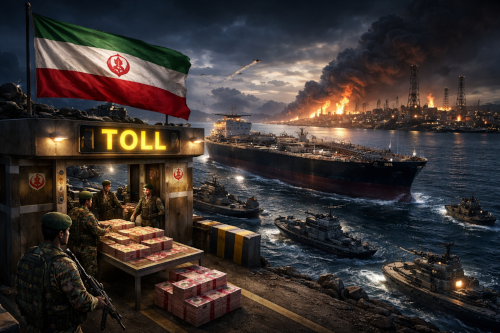
And yet, here we are four weeks into the Third Gulf War, and Iran is operating an actual toll booth at the world’s most critical energy chokepoint.
You did read that right. We’re not talking about monopoly money here, but an actual rate of $2 million per vessel for “safe passage” through the Strait of Hormuz.
Iran’s collecting the money — and they’re doing it in Chinese yuan.
You see, this isn’t just about control — it’s about cash. Iran is earning an estimated $139 million per day from oil exports right now.
For the record, that’s nearly $25 million more per day than they were making in February before the war started.
All that cash is above board, too — no need for dark fleet tankers sneaking off to unload their cargo in Malaysia before rerouting it to China.
If you think we’re at the end of this war, just ask yourself why on Earth Iran would negotiate peace when they’ve got President Trump lifting sanctions on their oil (and Russian exports, too!) to prevent even worse crude oil price spikes.
No, dear reader, this is just the beginning…
Entering The Third Phase of Trump’s Oil War
We’re entering a new phase of the Third Gulf War — and no, this isn’t the end of the fighting.
Truth is, we’ve never been further from a peace deal.
Despite Trump insisting this week that Iran is eagerly negotiating an end to the conflict, Iranian officials have repeatedly called this a lie.
The Best Free Investment You’ll Ever Make
Our analysts have traveled the world over, dedicated to finding the best and most profitable investments in the global energy markets. All you have to do to join our Energy and Capital investment community is sign up for the daily newsletter below.
Why would they sue for peace? After all, it’s been a month of disrupting global oil supplies on an unprecedented level, and Iran is in a better position now than they were before the war began.
So let’s break that timeline down a bit…
Phase One: The Insurance Lockdown
The first phase involved intensive bombing campaigns and Iranian threats to close the Strait of Hormuz. Spoiler alert: it wasn’t Iran that closed the strait initially — it was insurance companies significantly raising war-risk premiums for tanker transits that made it far too expensive for ship captains to risk the journey.
By March 5th, protection and indemnity insurance was removed entirely, making the economic risk too high for ship owners and grinding transit through the Strait down to a halt.
Before the war, roughly 138 vessels transited daily. Since this geopolitical mess began, tanker traffic dropped to just a trickle — only 21 tankers made it through in the first two weeks of conflict.
Then, the situation got worse as both sides started targeting energy facilities.
Phase Two: Infrastructure Attacks
The second phase saw Iran targeting the critical energy infrastructure of its Gulf neighbors.
Saudi Arabia was forced to reroute what exports it could to the Red Sea port of Yanbu via the East-West Crude Oil Pipeline.
Qatar declared force majeure on 17% of its LNG production after strikes damaged facilities at Ras Laffan.
Kuwait’s refineries at Mina Al-Ahmadi and Mina Abdulla were hit on March 19th.
The damage was staggering.
In the end, roughly 11 million barrels of daily output from OPEC’s biggest producers was shut-in. That’s what happens when storage tanks are filled up and export capacity becomes severely diminished.
Not surprisingly, oil prices went ballistic — DME Oman crude soared above $170 per barrel while Brent pushed past $120.
Now get ready for the next stage of this war.
Phase Three: The Toll Booth Regime
Iran has effectively established a “sovereign regime” over the Strait of Hormuz — their words, not mine.
They’re charging fees, denominating them in yuan to bypass Western financial systems, and selectively allowing passage to non-hostile nations.
In fact, India and China are already receiving Iranian oil as you read this! Two Indian LPG carriers were permitted to transit, as were several Chinese vessels.
Meanwhile, ships linked to the U.S. and Israeli war effort remain blocked.
And here’s the real kicker: roughly 11 million barrels per day remains offline, keeping prices elevated and Iran’s revenues flowing.
Each day supplies stay constrained, it extends the runway for high oil prices in 2026.
Crisis Breeds Opportunity: The Must-Buy Oil Stocks Right Now (Not Exxon!)
The old adage has never been more true than right now: crisis breeds opportunity.
The energy sector is the best-performing corner of the market by leaps and bounds — the S&P 500 Energy Index is up more than 20-25% year-to-date, absolutely crushing every other sector while the broader market chops sideways.
But here’s what everyone is missing…
While headlines focus on Big Oil — Exxon trading near $160, Chevron up 22% this year — the real hidden gems are being completely overlooked.
The veteran members of our investment community here know to whom I’m referring — the small, independent operators in the U.S. oil patch that are not only boosting production with less drilling (thanks to increased efficiencies), but are trading at far more attractive valuations than the whales.
Just look at the numbers: the S&P 500 Energy sector P/E sits at 22.6 as of March 24th, compared to a 5-year historical average of just 9.7 to 15.1.
In other words, at the sector level, energy stocks are actually expensive relative to their own history.
Exxon and Chevron? Forget about it. Exxon alone is trading at 24 times its forward earnings; Chevron at 30x. You may be paying a premium for quality and dividend growth, sure — but you’re also paying full price for businesses that are already looking overvalued.
And yet, Big Oil is being consistently outperformed by the small, hidden gems in the Permian oil patch — the must-buy oil stocks with lower breakevens, higher production growth potential, and the kind of attractive metrics that would make Warren Buffett himself blush like a schoolgirl.
Of course, that’s not even the best part, either.
Despite their strong performance, you don’t need oil to trade over $100 per barrel for them to push higher.
Until next time,

Keith Kohl
 Check us out on YouTube!
A true insider in the technology and energy markets, Keith’s research has helped everyday investors capitalize from the rapid adoption of new technology trends and energy transitions. Keith connects with hundreds of thousands of readers as the Managing Editor of Energy & Capital, as well as the investment director of Angel Publishing’s Energy Investor and Technology and Opportunity.
For nearly two decades, Keith has been providing in-depth coverage of the hottest investment trends before they go mainstream — from the shale oil and gas boom in the United States to the red-hot EV revolution currently underway. Keith and his readers have banked hundreds of winning trades on the 5G rollout and on key advancements in robotics and AI technology.
Keith’s keen trading acumen and investment research also extend all the way into the complex biotech sector, where he and his readers take advantage of the newest and most groundbreaking medical therapies being developed by nearly 1,000 biotech companies. His network includes hundreds of experts, from M.D.s and Ph.D.s to lab scientists grinding out the latest medical technology and treatments. You can join his vast investment community and target the most profitable biotech stocks in Keith’s Topline Trader advisory newsletter.


