

The countdown to June 2026 is underway.
That’s when Fervo Energy’s Cape Station in Beaver County, Utah, is scheduled to come online — the first large-scale commercial enhanced geothermal system in the United States.
We’re not talking about some tech demonstration or a small pilot project.
This is a commercial scale, 100 MW (Phase One) power plant that will be pumping out 400 MW of pure baseload power by 2028.
And with the right permit approval, Fervo will expand that power plant to 2 GW.
Think about that for a minute…
For decades, geothermal energy has been stuck in volcanic hotspots and tectonic boundaries. Iceland, California, Nevada — places where heat naturally rises close to the surface.
Everywhere else? Forget it.
That is, until now.
This is next-gen geothermal energy, enhanced geothermal systems (EGS) that utilizes the same horizontal drilling and hydraulic fracturing technology developed for oil and gas production. 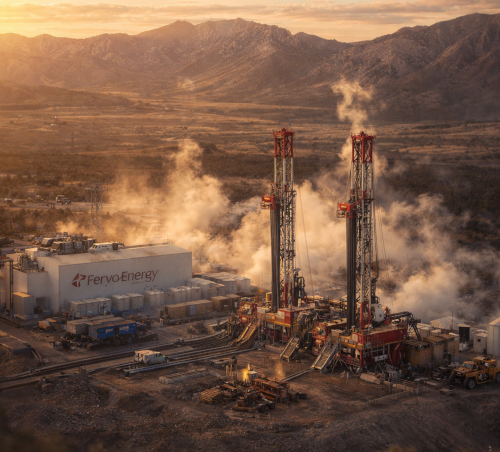
The plan is pretty simple if you think about it — drill down three to eight kilometers into hot, dry rock, then inject fluid to create fractures and pump the heated fluid back up.
Then, you generate electricity.
It’s not a hail mary, nor is it some white paper from some think tank at some university looking to develop some moonshot technology.
EGS technology works — anywhere!
My veteran readers know that with EGS, you don’t need to set up near a volcano, nor do you need a tectonic plate boundary.
Just good, old-fashioned hot rock.
And that, dear reader, exists everywhere… if you drill deep enough.
Now, Big Oil is starting to bet that EGS is bankable.
The Best Free Investment You’ll Ever Make
Our analysts have traveled the world over, dedicated to finding the best and most profitable investments in the global energy markets. All you have to do to join our Energy and Capital investment community is sign up for the daily newsletter below.
The AI Electricity Crisis Meets the Clean Power Crisis
If you’re wondering why this is so critical now, it’s because we’re witnessing an incredible moment for U.S. power demand.
The truth is, data centers are consuming electricity faster than the grid can supply it.
The latest numbers out of the IEA project that global data center demand will more than double by 2030 — reaching 945 terawatt-hours, roughly equivalent to Japan’s entire electricity consumption.
In the United States alone, data center electricity usage is projected to rise from 4% to 7.8% of regional consumption between 2025 and 2030.
What about gas turbine wait times? Five years or more.
Or how about grid interconnection queues? Currently 2-3 years, with projects taking 55 months on average from interconnection requests to commercial operations.
Granted, solar and wind can’t solve this problem, because AI training and inference require 24/7 baseload power, not intermittent generation that stops when the sun sets or the wind dies.
Unfortunately, the common tropes you hear about solar and wind ring all too true — solar stops at sunset, and wind dies when it’s calm outside. These clean renewable sources simply don’t provide the steady baseload power that’s necessary.
We’re years (decades?) away from having the battery capacity to make up for that intermittency.
But this is where enhanced geothermal changes the equation.
One Stanford University study published last January found that EGS providing just 10% of U.S. electricity supply would reduce onshore wind capacity needs by 15%, solar capacity by 12%, and battery storage requirements by 28%.
More importantly, total land requirements for renewable energy infrastructure would drop from 0.57% to 0.48% of the country’s combined land area.
And the cost? Well, that’d be comparable to renewables-only scenarios.
The study analyzed 150 countries and concluded that EGS can readily substitute for coal and nuclear electricity — providing constant baseload power day and night.
Unlike solar and wind, which require expensive backup power to maintain grid stability, EGS delivers firm capacity without the intermittency problem.
Even the USGS estimates that 135 GW of electric power generation is available from EGS in the Great Basin alone.
135 GW!
To put a little perspective on this, the entire U.S. currently has 2.7 GW of conventional geothermal capacity — just 0.2% of U.S. summer generating capacity.
EGS could expand U.S. geothermal power by 50 times in one region of the Southwest.
Of course, other studies project up to 150 GW of cost-effective geothermal power operating nationwide by mid-century.
The National Laboratory of the Rockies estimates 90 GW of economically viable EGS capacity could be built across the country by 2050.
And you can bet that the biggest tech companies on the planet are already moving.
Google-backed Fervo’s 3.5 MW pilot project in Nevada went online in November 2023 and has been supplying power directly to NV Energy ever since.
Meta signed agreements with geothermal developers to power its data center operations with up to 150 MW of geothermal energy — the first new geothermal power east of the Rocky Mountains.
The U.S. Department of Defense partnered with six geothermal developers to build EGS plants for Air Force, Army, Navy, and Marine bases across California, Idaho, Nevada, New Mexico, and Texas.
Again, we’re not looking at a speculative gamble.
This is happening… and the countdown for Fervo’s commercial scale EGS plant is down to two months.
But here’s where it gets interesting…
You see, the same fracking technology that environmental groups spent decades fighting is now unlocking clean, carbon-free baseload power. Remember, EGS uses horizontal drilling and hydraulic fracturing — the exact playbook that made the United States the world’s largest oil and gas producer.
The irony is almost impossible to miss — almost.
Fervo certainly isn’t the only player in town, too.
Mazama Energy is pushing the technology even further at Oregon’s Newberry Volcano.
In 2025, the company demonstrated a 331°C reservoir and established circulation between injection and production wells, and its 2026 program targets SuperHot Rock conditions above 400°C — drilling an observation well at some point in the next few months, then an injector this summer, and turning it into a producer by year-end.
Higher temperatures mean more power output per well.
And if there’s one thing U.S. companies have perfected over the last 20 years, it’s drilling on U.S. soil.
Drilling times are already decreasing with each new well, and Fervo reports “best-in-class operational performance” at Cape Station, with efficiencies improving as the company gains experience.
After decades of being relegated to volcanic regions, geothermal energy is finally breaking out.
Slowly but surely, the headlines are starting to capture more attention.
And you might be surprised which companies are standing far at the front of the line for this opportunity.
I recommend taking just a few minutes out of your day to check them out for yourself right away.
Until next time,

Keith Kohl
 Check us out on YouTube!
A true insider in the technology and energy markets, Keith’s research has helped everyday investors capitalize from the rapid adoption of new technology trends and energy transitions. Keith connects with hundreds of thousands of readers as the Managing Editor of Energy & Capital, as well as the investment director of Angel Publishing’s Energy Investor and Technology and Opportunity.
For nearly two decades, Keith has been providing in-depth coverage of the hottest investment trends before they go mainstream — from the shale oil and gas boom in the United States to the red-hot EV revolution currently underway. Keith and his readers have banked hundreds of winning trades on the 5G rollout and on key advancements in robotics and AI technology.
Keith’s keen trading acumen and investment research also extend all the way into the complex biotech sector, where he and his readers take advantage of the newest and most groundbreaking medical therapies being developed by nearly 1,000 biotech companies. His network includes hundreds of experts, from M.D.s and Ph.D.s to lab scientists grinding out the latest medical technology and treatments. You can join his vast investment community and target the most profitable biotech stocks in Keith’s Topline Trader advisory newsletter.


