

Qatar wasn’t enough.
Last week, Tropical Cyclone Narelle — a Category 4 storm packing 165 km/h winds — slammed into Western Australia’s LNG infrastructure.
But the damage wasn’t too bad, right?
Sorry to say, it was.
Chevron’s Gorgon plant, which held a capacity of 15.6 million tonnes per year of capacity, saw one of its three trains go offline. The company’s Wheatstone platform was forced to suspend production — a facility that added 8.9 million tonnes per year.
That’s not to mention production interruptions at Woodside Energy Group’s North West Shelf export plan.
In total, we’re talking about HALF of Australia’s LNG exports from just these three facilities.
That’s 8% of global LNG supply knocked offline by a single weather event.
And remember, this happened at the absolute worst possible time as Qatar declares force majeure on 17% of its LNG production.
Think about that for a minute…
The Best Free Investment You’ll Ever Make
Our analysts have traveled the world over, dedicated to finding the best and most profitable investments in the global energy markets. All you have to do to join our Energy and Capital investment community is sign up for the daily newsletter below.
We’re talking about one-quarter of global LNG supply going offline at the drop of a hat.
I have a feeling you can guess what happened next, too.
Asian LNG prices doubled in some markets.
Japan, which gets 40% of its LNG from Australia, just watched helplessly as a critical supply line went dark.
But here’s the timing that matters…
This happened just three weeks after Iranian drones knocked out 12.8 million tonnes per year of Qatari LNG capacity at Ras Laffan — damage that won’t be repaired for three to five years.
You want to know the energy source that doesn’t care about cyclones in the Pilbara or Iranian drones in the Persian Gulf?
Coal.
It sits in the ground, gets dug up, and burns. No tankers required. No maritime chokepoints. No weather delays. Just baseload power that works when everything else fails.
Asia is learning this lesson in real time — and it’s creating a multi-year bull market for an industry Wall Street declared dead.
Asia’s Dirty Energy Secret
Remember the “bridge fuel” narrative?
Natural gas was supposed to be the transition energy — cleaner than coal, abundant enough to carry us until renewables could handle baseload demand.
Spoiler alert: the bridge may have just collapsed.
Now, we’re seeing Thailand restart coal-fired power plants that were decommissioned in 2025. Meanwhile, South Korea is lifting its caps on coal electricity generation.
And then there’s India, a country burning more coal to meet peak summer demand of 270 gigawatts — nearly twice the total electricity capacity of Spain.
The Philippines declared a “state of national energy emergency” and ramped up coal-fired power… Vietnam, Indonesia, Japan — all boosting coal use.
When LNG spot prices in Thailand hit $24 to $25 per million BTU — eight times the $3.16 U.S. Henry Hub price — the economics of energy security get very simple very fast.
I think South Korea tells the story best. We’re looking at a country that committed $127 billion to fossil fuels over the past decade — thirteen times what it spent on renewables.
In 2024 alone, South Korea spent $120.1 billion on fuel imports, with 60% of that going to LNG.
What about renewables? Well, they accounted for just 10% of South Korea’s electricity mix in 2024.
And yet, the country still pledges to retire most coal plants by 2040 and halve emissions by 2035.
We’re not buying it, are we?
The thing is, India’s situation is even more dramatic.
Gas-fired generation in India collapsed to about one terawatt-hour in March against a target of two terawatt-hour.
A few weeks ago, the Indian government issued an order redirecting natural gas away from the power sector entirely.
Coal, which already generates more than 70% of India’s electricity, is now carrying the full load for peak summer demand of 270 GWs.
They even paused air-quality rules to allow restaurants to burn coal during this gas shortage.
I guess when you’re choosing between smog and blackouts, you choose smog.
Now here’s where it gets interesting for Asia’s dirty energy secret…
China is the renewable energy superpower.
Oh yes, you read that right. The Middle Kingdom installed 300 GWs of solar power and 100 GWs of wind power in 2025 — more than the rest of the world combined.
Granted, China also brought 78 GWs of new coal capacity online last year, with construction started on another 83 GWs.
In total, China commissioned more than 50 large coal-fired units in 2025.
Despite the record achievements in renewable growth, coal still accounts for 56% of China’s primary energy.
Although that’s technically less than the 69% of coal’s share in 2015, total energy demand is a helluva catch, and the absolute volume of coal consumed is higher than ever.
China now burns 40% more coal than the rest of the world combined.
I believe energy security explains the paradox.
You see, coal is the only fossil fuel China doesn’t have to import through vulnerable pipelines, or along sea routes that pass through precarious chokepoints like the Strait of Hormuz. China holds roughly 13% of the world’s recoverable coal reserves.
It’s abundant, domestic, and perhaps most importantly, immune to Middle Eastern geopolitics.
China learned this lesson the hard way in 2021, when power shortages affected 20 provinces as coal prices spiked and generators cut output to limit losses.
The following year, a severe drought in Sichuan caused hydropower output to drop 80%.
Factories were forced to close as applications for new coal plant permits hit record levels.
If you think China didn’t have a chance to change course, that’s not exactly true. The country’s 15th Five-Year Plan was unveiled recently.
Rather than putting coal to bed, Beijing doubled down.
Now, there are 243 GWs of new coal power permitted or under construction, with another 149 GWs announced.
The government missed its energy density target for the first time. Utilization rates are dropping — plants running well below capacity — which means China is building coal infrastructure it doesn’t even need.
Cheap energy trumps climate goals every single time.
Even Taiwan — which achieved “nuclear-free” status in May 2025 after shutting down its last reactor — just reversed course.
President Lai Ching-te announced in March that Taiwan is submitting plans to restart two nuclear plants: Guosheng and Ma-anshan, which provided roughly 20% of Taiwan’s electricity before decommissioning.
As for the timeline, they won’t see operational relief until late 2028 and 2029.
If we’ve learned nothing else this month, it’s that global energy supply lines can be fragile.
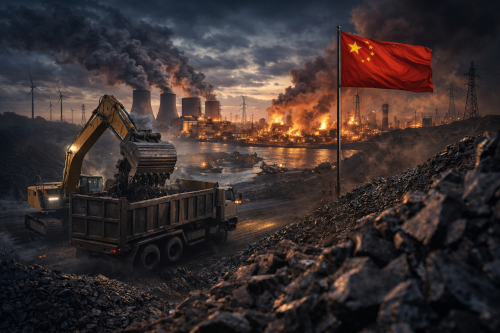
Coal’s Unexpected Comeback Story
Here’s what everyone is overlooking as the Middle East conflict steals headlines…
U.S. natural gas is trading around $3.00 per million BTU at Henry Hub — so domestically, it’s extremely cheap and abundant.
But what about Asian LNG spot prices? Well, now we’re talking prices as high as $24 to $25 per million BTU in Thailand.
That’s an eight-times differential.
Right now, our power plants are enjoying dirt-cheap natural gas while the rest of the world scrambles for alternatives.
U.S. coal companies — written off as a dying industry just five years ago — are suddenly sitting on export gold.
Newcastle coal, the Asia benchmark price, has risen just 13% since the war began. Now compare that to LNG, which is up 70% over the same period.
All of a sudden, coal is an affordable option.
And Indonesia, the world’s largest coal exporter, is prioritizing domestic use over exports — tightening global supply and pushing prices higher.
Of course, three U.S.-based coal stocks are particularly well-positioned for this moment.
- Peabody Energy (BTU): The largest U.S. coal producer with an 18.7% market share. These guys produced 95,789 thousand short tons in 2024 and pulled in $4.95 billion in revenue in 2023. Peabody also happens to export to 26 countries, and maintains offices in China, Australia, and Singapore.
- Core Natural Resources (CNR): Formed in January of 2025 from the merger of Arch Resources and CONSOL Energy, CNR controls 16.4% of U.S. production and owns a 65% stake in the Dominion Terminal Associates export facility in Newport News, Virginia. The company ships both metallurgical coal for steelmaking and thermal coal for power generation.
- Alpha Metallurgical Resources (AMR): As the number-one U.S. producer of met coal, AMR sold 15.3 million tons in 2025. In fact, 73% of its revenue came from exports, and the company serves 19 countries, with 39% of shipments going to India.
Believe me, these companies saw this moment coming.
While environmentalists fought against coal plants tooth and nail in West Virginia, Asian governments were building LNG import terminals and betting their energy security on a fuel that travels by tanker through some of the world’s most volatile regions.
Then, Qatar went offline for half a decade… and a cyclone took out Australian LNG exports.
Suddenly, coal — the fuel everyone left for dead — has become quite a competitive and reliable option.
India is desperate for baseload power to meet 270 gigawatt peak demand, and even the EU is reconsidering coal as its LNG alternative becomes prohibitively expensive.
That leaves the U.S., with its Gulf Coast export capacity and domestic reserves in an opportune position as a reliable supplier.
And the Iran war may have just sparked a multi-year bull market for an industry that was being abandoned for more than a decade.
Until next time,

Keith Kohl
 Check us out on YouTube!
A true insider in the technology and energy markets, Keith’s research has helped everyday investors capitalize from the rapid adoption of new technology trends and energy transitions. Keith connects with hundreds of thousands of readers as the Managing Editor of Energy & Capital, as well as the investment director of Angel Publishing’s Energy Investor and Technology and Opportunity.
For nearly two decades, Keith has been providing in-depth coverage of the hottest investment trends before they go mainstream — from the shale oil and gas boom in the United States to the red-hot EV revolution currently underway. Keith and his readers have banked hundreds of winning trades on the 5G rollout and on key advancements in robotics and AI technology.
Keith’s keen trading acumen and investment research also extend all the way into the complex biotech sector, where he and his readers take advantage of the newest and most groundbreaking medical therapies being developed by nearly 1,000 biotech companies. His network includes hundreds of experts, from M.D.s and Ph.D.s to lab scientists grinding out the latest medical technology and treatments. You can join his vast investment community and target the most profitable biotech stocks in Keith’s Topline Trader advisory newsletter.


