

Few people know about the voyage of the Methane Pioneer.
Built in 1945, the Methane Pioneer was a converted World War II cargo ship measuring 106 meters long and fitted with five tanks insulated with balsa wood and glass fiber.
This tanker holds its place in history as the first ship to carry LNG internationally.
Roughly 67 years ago, the Methane Pioneer left Lake Charles, Louisiana, carrying 2,000 tons of liquefied natural gas chilled to minus 258 degrees Fahrenheit.
Newspaper headlines at the time called the voyage hazardous, yet 27 days later the Methane Pioneer docked safely at Canvey Island, England.
The $11 million gamble paid off handsomely.
Of course, the world’s first transoceanic LNG shipment also proved you could super-cool natural gas and ship it across oceans, and that single voyage launched an industry.
Now fast-forward to today…
The Best Free Investment You’ll Ever Make
Our analysts have traveled the world over, dedicated to finding the best and most profitable investments in the global energy markets. All you have to do to join our Energy and Capital investment community is sign up for the daily newsletter below.
The United States exported 111 million metric tons of LNG last year, marking the first time someone exported more than 100 million tons in a single year.
Make no mistake, America is now the world’s largest LNG exporter.
Then everything changed in just one month.
What happened? On March 18, Iranian drones struck Qatar’s Ras Laffan Industrial City — the world’s largest LNG export hub.
Two of Qatar’s 14 liquefaction trains went offline overnight, and QatarEnergy declared force majeure on contracts with buyers across Europe and Asia.
In the end, approximately 17% of Qatar’s export capacity was effectively shut in for at least five years.
In case you’re wondering, that’s 12.8 million metric tons per year of LNG taken right off the table.
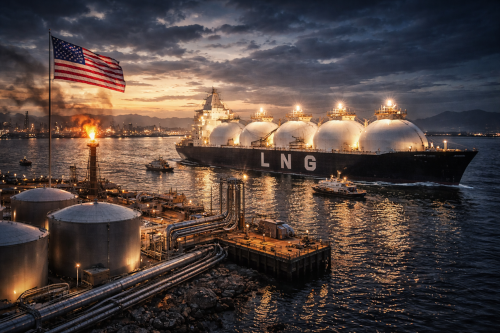
The ship that proved LNG could cross the Atlantic in 1959 just set the stage for the industry rescuing global energy markets in 2026.
This time, it’s all American gas.
Look, Qatar isn’t just another LNG exporter.
It’s THE LNG exporter.
Before the war, 81 million metric tons per year flowed out of Qatar, with 82% of that LNG heading straight for Asian markets: China, Japan, India, South Korea, Pakistan — all dependent on Qatari gas.
The March 18 strikes at Ras Laffan obliterated the math.
In the blink of an eye, Asian LNG prices spiked 143%, to $25.30 per million British thermal units; European gas benchmarks jumped 50%–85% in a week — the largest gain since Russia invaded Ukraine.
But here’s the catch…
Even if the war ends tomorrow, those trains won’t flow for years.
QatarEnergy CEO Saad al-Kaabi told us that much — up to half a decade of missing supply in a market already running tight.
When the Strait of Hormuz was locked down, so was 20% of the global LNG supply.
Europe is entering 2026 with storage at five-year lows — roughly 140 cargoes below normal. They burned through reserves during a brutal winter. Now they’re staring at an empty tank heading into summer refill season.
Think about that for a minute.
The world just lost its largest LNG exporter for half a decade. Buyers can’t wait. They need gas now.
There’s exactly one country with the capacity to fill the gap: the United States.
Right now our LNG terminals are running at 95% capacity, and exports reached 15 billion cubic feet per day in 2025.
But here’s what matters: Another 13.9 Bcf/d of liquefaction capacity is coming online through 2029, which means that North America will deliver more than 85% of new global LNG supply in 2026.
The U.S. has the gas, the infrastructure, the financing, the projects under construction… and — this is key — destination-flexible contracts that let buyers redirect cargoes wherever needed.
Meanwhile, Qatar’s rigid oil-indexed contracts read like an old, unusable playbook. However, that’s the least of their worries right now as Iranian missiles rain fire down on their energy facilities.
If it’s not clear by now, supply diversity and geopolitical security just became more important than price, and you can bet that buyers are willing to pay a premium for reliability.
The Methane Pioneer opened the door in 1959, and the Third Gulf War in 2026 just blew that opportunity off the hinges.
It’s not difficult to see that the U.S. LNG is about to dominate global energy markets for the next five years.
For us, that puts the ball into the hands of three U.S. LNG players, each with a chance right now to cement their place in the global LNG trade:
Cheniere Energy (NYSE: LNG) is the obvious play. America’s largest LNG exporter with more than 51 million metric tons of annual capacity. The company delivered 670 cargoes in 2025, with 95% of its capacity contracted through 2030 locking in cash flow for years.
Venture Global (NYSE: VG) is the high-beta version. The stock surged 180% year to date during the Qatar crisis as its fourth-quarter revenue jumped 193%, to $4.45 billion. However, the key difference here is that Venture Global sells nearly one-third of its output on the spot market. That kind of direct exposure to elevated LNG prices will pay off in spades as Asian markets pay $25 per MMBtu
Then there’s NextDecade (NASDAQ: NEXT) as your more speculative bet. Its Rio Grande LNG project is an $18 billion facility under construction in Texas. Once completed in 2028, capacity will reach 27 million tons per year of capacity. Target completion: 2028.
Remember the crisis timeline…
Qatar’s repairs will take 3–5 years minimum, but Asia and the EU need their replacement supply NOW.
The U.S. is the only player with capacity ready to scale.
That’s not a temporary trade, dear reader, it’s a structural shift that positions American LNG exporters as the biggest winners from this geopolitical chaos.
Until next time,

Keith Kohl
 Check us out on YouTube!
A true insider in the technology and energy markets, Keith’s research has helped everyday investors capitalize from the rapid adoption of new technology trends and energy transitions. Keith connects with hundreds of thousands of readers as the Managing Editor of Energy & Capital, as well as the investment director of Angel Publishing’s Energy Investor and Technology and Opportunity.
For nearly two decades, Keith has been providing in-depth coverage of the hottest investment trends before they go mainstream — from the shale oil and gas boom in the United States to the red-hot EV revolution currently underway. Keith and his readers have banked hundreds of winning trades on the 5G rollout and on key advancements in robotics and AI technology.
Keith’s keen trading acumen and investment research also extend all the way into the complex biotech sector, where he and his readers take advantage of the newest and most groundbreaking medical therapies being developed by nearly 1,000 biotech companies. His network includes hundreds of experts, from M.D.s and Ph.D.s to lab scientists grinding out the latest medical technology and treatments. You can join his vast investment community and target the most profitable biotech stocks in Keith’s Topline Trader advisory newsletter.


