

Wednesday night, 9 p.m.
President Trump addressed the nation from the White House, comparing the Iran war to every major American conflict of the past century.
The history buffs among you knew the timelines well before he told us…
World War I lasted four years, the Second World War took six. Korea dragged on for three years, while the quagmire known as Vietnam stretched nearly two decades. Of course, we can’t forget Iraq, which dragged on for eight years.
So when President Trump bragged that we’ve only been executing Operation Epic Fury for just 32 days, I couldn’t tell if that was a good thing or not.
That’s 32 days, folks.
Not years… days.
The message was clear, too.
This war is shorter, faster, and more efficient than any conflict in American history. Promises were made to hit Iran “extremely hard” over the next two or three weeks and then wrap it up.
But here’s what Trump didn’t mention.
Those previous wars — brutal as they were — never shut down 20% of global oil supply.
World War II didn’t choke off the Strait of Hormuz. Vietnam didn’t force Saudi Arabia to shut in 10 million barrels per day of production. Korea didn’t trigger a 3–5-year repair timeline for Qatar’s LNG facilities.
And — perhaps the most important statistic in this comparison — global oil demand wasn’t a jaw-dropping 105 million barrels per day when our troops stormed the beaches of Normandy.
This war IS different.
Not because of its length, mind you, but because of the timeline running underneath it — the one Trump didn’t talk about. To be fair, it’s a talking point he doesn’t dare touch publicly.
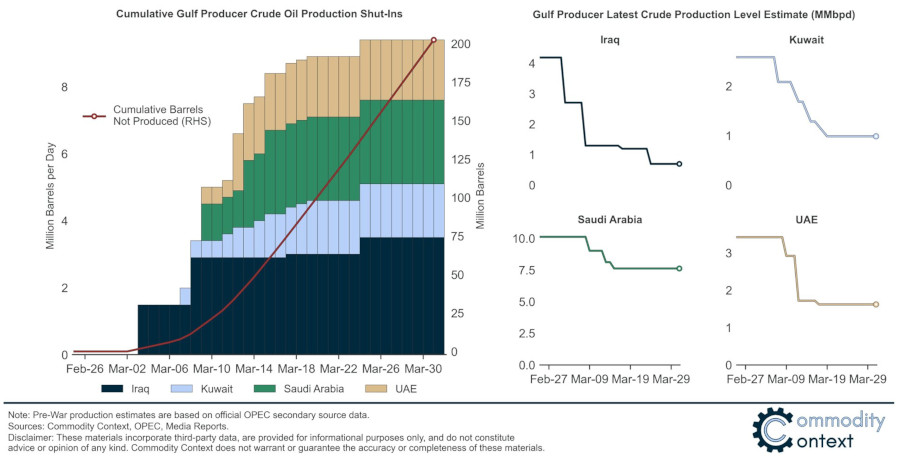
Since Operation Epic Fury began, we’ve lost roughly 200 million barrels of oil to production shut-ins. Meanwhile, floating storage is being drained faster than most people realize, and the massive SPR releases announced are more of a joke after you look at the actual flow rates that will bring those barrels to market.
In other words, the buffers are almost gone.
And what comes next is an “oil cliff” that will make crude prices spike far higher than where they are now — the moment when strategic reserves, floating storage, and sanctions-exempt Iranian barrels all run dry simultaneously.
But, hey, President Trump is confident that the war will be over in weeks (months are more realistic).
However, the oil market needs it to be over in days.
The Best Free Investment You’ll Ever Make
Our analysts have traveled the world over, dedicated to finding the best and most profitable investments in the global energy markets. All you have to do to join our Energy and Capital investment community is sign up for the daily newsletter below.
The Third Gulf War’s Hidden Oil Clock
This week, Brent crude is trading above $112 per barrel, WTI prices spiked well into triple-digit territory, and this energy crisis has finally hit our shores directly as our gasoline prices topped $4 per gallon for the first time since late 2023.
I want to stress that these aren’t temporary spikes — higher oil prices are the new normal.
The IEA called it “the largest supply disruption in the history of the global oil market.”
As I mentioned, Gulf producers have collectively shut-in more than 10 million barrels per day, and the Saudis alone slashed output below 8 million barrels per day. In fact, the Saudi kingdom’s only hope to avert total disaster is rerouting exports through its East-West pipeline to the Red Sea port of Yanbu.
Unfortunately, the pipeline is pushing 3-5 million barrels per day westward, but that’s the limit; the system was designed primarily for lighter crude grades and can’t handle full Saudi production.
Think about what that means…
Saudi Arabia — the world’s largest oil exporter, the holder of most global spare capacity — is being forced to pull barrels off the market instead of adding them. Every day this continues, those barrels stay in the ground.
Take a look at how bad things have gotten:
And if you think that’s bad, keep in mind that Qatar’s situation is even worse.
After Iranian drones hit the Ras Laffan LNG facility in early March, QatarEnergy declared force majeure on all exports — 81 million metric tons per year of liquefied natural gas, mostly bound for China, Japan, India, South Korea, and Pakistan.
The repair timeline? We’re talking 3–5 years — not months, YEARS!
Even if the war ends tomorrow, Qatar’s LNG isn’t flowing.
The damage is structural, and the timeline is catastrophic for global gas markets. This is taking place as the EU emerges from winter with storage tanks at 30% capacity.
Not surprisingly, Dutch TTF gas benchmarks nearly doubled to over 60 euros per MWh by mid-March.
And then there’s Iran’s tollbooth.
The Islamic Revolutionary Guard Corps is now officially operating a checkpoint system in the Strait of Hormuz.
Vessels wanting to transit must submit detailed information to Iranian authorities for approval. If granted clearance, they receive routing instructions through IRGC-monitored corridors near Larak Island.
The toll? That’s about a dollar per barrel, so for a standard VLCC tanker carrying 2 million barrels, that’s $2 million per transit.
Of course, payment is accepted in Chinese yuan or cryptocurrency — stablecoins preferred.
At least 26 vessels have used the system so far.
Traffic through the strait has collapsed 95% from normal levels, and nearly 2,000 ships (not to mention 20,000 sailors) are stranded on both sides, waiting.
So the IRGC’s toll booth is open for business, and it’ll generate vital revenue for the IRGC while the world burns through its remaining oil buffers.
Every day this war lasts means one thing: Oil prices stay elevated.
What about the 400 million barrel IEA strategic release? Flowing at maximum rates but finite.
But what about the 140 million barrels of sanctions-exempt Iranian oil in floating storage? That’s rapidly draining and buys us a week or two, tops.
OPEC’s biggest producers will take months and years to get back to pre-war levels. Kuwait’s national oil company just recently reported that it could take 3–4 months to return to full production even after the war ends.
You and I both know that oil and gas fields don’t just restart instantly, and bringing those wells back online safely will take time.
But that mid-April timeline keeps coming up… the moment when those supply buffers run out.
That’s when the oil market hits the wall and all hell breaks loose.
And here’s the most frightening part: President Trump’s military plans are always a wild card. Remember when we suddenly learned that we snatched Maduro? Or perhaps when Israel and the U.S. decimated Iranian nuclear sites last year?
Things could easily get worse before they get better.
The Only Win-Win Situation in This Whole Bloody War
Are you wondering who’s winning as oil prices are entrenched above $100 per barrel and Middle Eastern supply is offline for the foreseeable future?
Well, our Permian oil drillers for sure. Higher WTI prices are printing cash that’ll flow into their war chests.
But there’s a bigger winner in this mess, and that secret lies in a pipeline that began commercial operations on May 1, 2024.
My veteran readers remember when the Trans Mountain Expansion Project tripled capacity from 300,000 barrels per day to 890,000 bpd, connecting landlocked Alberta oil sands to the Pacific Coast port of Vancouver.
Before this pipeline started operations, Canadian oil producers had one customer: the United States.
Now? They’ve got the world’s most desperate oil buyer beating down their door.
China.
Between May 2024 and spring 2025, Canadian crude shipments to China averaged 207,000 barrels per day — up from just 7,000 barrels per day in the decade prior!
During the same period, shipments to the U.S. via Trans Mountain averaged 173,000 barrels per day.
As you can see, China finally overtook the United States as the top buyer of oil from the Trans Mountain pipeline.
It’s about damn time, too.
As of October 2025, roughly 70% of oil cargoes departing British Columbia were bound for Chinese ports, and the Asia-Pacific region now accounts for 64% of Trans Mountain exports, led overwhelmingly by China.
We’re witnessing a fundamental reorientation of global oil flows.
China’s crude oil imports from the Middle East normally transit either the Strait of Malacca or the Strait of Hormuz.
Both routes are now problematic — Hormuz is effectively closed, and Malacca remains vulnerable to geopolitical disruption.
Canadian oil solves this dilemma entirely with Canadian crude.
In fact, North Pacific shipments are faster, more cost-effective, and completely bypass the Middle Eastern choke points that have made oil supply so precarious.
Canada shipped 15.5 million tons of oil to China in 2025 — a 168% increase from the previous year.
The impact on pricing has been immediate.
Western Canadian Select — Canada’s benchmark for heavy oil — typically trades at a steep discount to West Texas Intermediate.
However, Canadian producers are getting better prices because they’re no longer captive to U.S. refiners — they’ve finally got competition for their barrels now.
My point is, Canadian producers with access to Trans Mountain capacity are printing money.
They’re selling into the world’s hungriest oil market at elevated prices while the Middle East burns and China is stockpiling aggressively.
The best-positioned Canadian oil producers — the ones with significant oil sands operations and secured Trans Mountain shipping capacity — are the quiet winners of the Third Gulf War.
While Trump talks about wrapping up the war in weeks and oil prices gyrate on geopolitical headlines, Canadian producers are executing a simple strategy: Pump more barrels, ship them to China, collect premium prices.
There’s a reason why the world’s most powerful investors have had their eyes on a small batch of must-own Canadian oil stocks generating a fortune as this war rages on.
Until next time,

Keith Kohl
 Check us out on YouTube!
A true insider in the technology and energy markets, Keith’s research has helped everyday investors capitalize from the rapid adoption of new technology trends and energy transitions. Keith connects with hundreds of thousands of readers as the Managing Editor of Energy & Capital, as well as the investment director of Angel Publishing’s Energy Investor and Technology and Opportunity.
For nearly two decades, Keith has been providing in-depth coverage of the hottest investment trends before they go mainstream — from the shale oil and gas boom in the United States to the red-hot EV revolution currently underway. Keith and his readers have banked hundreds of winning trades on the 5G rollout and on key advancements in robotics and AI technology.
Keith’s keen trading acumen and investment research also extend all the way into the complex biotech sector, where he and his readers take advantage of the newest and most groundbreaking medical therapies being developed by nearly 1,000 biotech companies. His network includes hundreds of experts, from M.D.s and Ph.D.s to lab scientists grinding out the latest medical technology and treatments. You can join his vast investment community and target the most profitable biotech stocks in Keith’s Topline Trader advisory newsletter.


