

Some of you might remember the little power hiccup back in the summer of 2024.
Don’t feel bad if it doesn’t ring a bell. Most of the market overlooked this when the voltage fluctuation in northern Virginia triggered the simultaneous disconnection of 60 data centers.
Sounds pretty bad, doesn’t it? Well, it was.
Within seconds, 1,500 megawatts of power surged back onto the grid — enough electricity to power 1.5 million homes.
Grid operators scrambled to prevent cascading outages that could have darkened the entire Mid-Atlantic.
That near-miss in Virginia became a wake-up call for the Great Lakes region, which is now facing the same pressure.
In fact, Ohio alone expects data center electricity demand to nearly double from 1.5 gigawatts to 3 gigawatts by 2030; Michigan’s DTE Energy just inked a 1.4-gigawatt data center deal — increasing the utility’s total demand by 25% in a single contract.
That power demand tsunami is coming, dear reader.
In just four years, data centers in the eight-state Great Lakes region are expected to consume the electricity equivalent of 8 million households — that’s approximately 20 million people.
So when President Trump stood before Congress this week and announced the “Rate Payer Protection Pledge” — an agreement with major tech companies to build their own power plants so consumers don’t foot the bill for AI’s electricity appetite — everyone should sit up and take notice.
The Best Free Investment You’ll Ever Make
Our analysts have traveled the world over, dedicated to finding the best and most profitable investments in the global energy markets. All you have to do to join our Energy and Capital investment community is sign up for the daily newsletter below.
Trust me, this wasn’t a mere Presidential suggestion… It was a directive.
You can understand why, right? After all, electricity prices have climbed 6.3% year-over-year, and last year alone we saw utilities approving a $11.6 billion in rate increases.
Of course, data centers drove most of that new capacity.
So, President Trump made it clear: Big Tech will build and pay for its own generation or face regulatory consequences.
Although this solves a problem that was about to break the grid, it’s writing a roadmap that’ll lead to a windfall for the companies positioned to deliver the kind of strong, reliable baseload power those data centers crave.
And to do that, there’s only two players that can deliver the goods…
Nuclear and natural gas just became the only game in town.
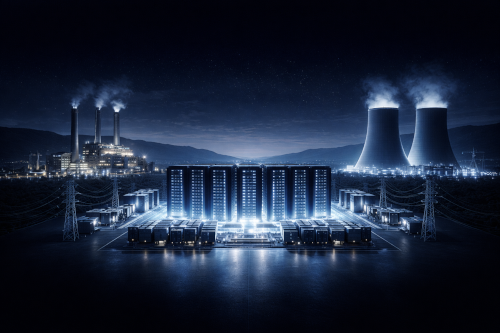
The Power Demand Tsunami Coming for the Grid
Look, the scale of what’s coming isn’t mere speculation. All last year we saw Big Tech scrambling to secure contracts.
There’s a good reason why, too. U.S. data centers consumed 183 terawatt-hours of electricity in 2024.
By 2030, that number will hit 426 TWh — a 133% increase in just six years.
For a little perspective, that’s more electricity than the entire country of Japan uses in a single year.
The Great Lakes region has been ground zero, with annual demand projected to grow 2-3% for the next decades —- driven almost entirely by AI computing.
Meta’s Prometheus data center in New Albany, Ohio became the world’s first requiring over one gigawatt of dedicated power — roughly equivalent to a large nuclear reactor.
That’s not an outlier, either, but rather the new baseline.
You see, AI training runs don’t pause for cloudy days or calm winds. That’s why we keep talking about the fact that these data centers need 24/7 baseload power that’ll never flicker or taper off based on the weather.
Think about it…
Solar runs about 6 hours a day on average, while wind runs maybe 9 hours. Sure, battery storage can bridge gaps for hours (maybe a day), but remember that those data centers process billions of transactions per second.
Trust me, they’re going to need power with a bit more reliability.
Not surprisingly, natural gas is our immediate winner, and supplies about 40% of the power we use on a daily basis.
We’ll rely on it even more as AI demand accelerates faster than nuclear or renewables can be deployed.
I believe Goldman Sachs put it as blunt as possible: Natural gas is “king right now” for deployment speed and cost. Nuclear is preferred for long-term baseload, but the lead times don’t match the urgency.
Nuclear has clearly become the long game for power demand, you can take that to the bank… Big Tech already is!
Last June, Meta signed a 20-year power purchase agreement with Constellation Energy for 1,121 megawatts from the Clinton Clean Energy Center in Illinois, starting June 2027.
That deal alone saved a nuclear plant scheduled for closure and locked in two decades of carbon-free power.
Then last month, Meta went back for seconds, this time for 2,176 MW from Vistra’s Perry and Davis-Besse plants in Ohio, plus Beaver Valley in Pennsylvania.
That’s enough to power 2 million homes, contracted through 2046.
Meanwhile, we know Microsoft is bringing Three Mile Island back online in 2027 under a 20-year agreement with Constellation for 837 MW, and Amazon has locked in 1,920 MW from Talen Energy’s nuclear fleet through 2042.
These aren’t pilot programs, dear reader, they’re multi-decade infrastructure commitments with fixed pricing and guaranteed offtake.
But here’s the catch…
You know our excitement over next-gen nuclear technology.
However, small modular reactors won’t help anyone in the near term. SMRs are the future everyone talks about, but they’re not arriving in time.
Remember, the industry needs 85-90 gigawatts of new capacity by 2030, and SMRs might deliver 10% of that if everything goes perfectly.
Traditional nuclear and natural gas will carry the load until then.
Look, you either run data centers on power that works 24/7, or you don’t run them at all.
Wind and solar contribute, sure. But when Meta needs a gigawatt of continuous power for Prometheus, they’re signing contracts with nuclear plants and gas turbines — not solar farms.
Trump’s Roadmap For Big Tech Power Plays
Look, we know there’ll be immediate and long-term winners, both of which center on the players bringing that baseload demand to market.
Maybe it’s Vistra locking Meta into 2,176 MW across three nuclear plants through 2046. That’s not a one-year power contract — that looks more along the lines of a generational revenue stream.
Or Talen Energy securing Amazon’s 1,920 MW commitment through 2042.
Trust me, this isn’t guesswork, especially when multi-decade plans are being signed on the dotted line.
That’s why gas turbines have sold out through 2030 because utilities know nuclear takes years to build and SMRs won’t scale in time — natural gas is the bridge fuel that keeps data centers online while long-term nuclear capacity gets built.
And we already know how the smart money is positioning itself right now.
Until next time,

Keith Kohl
 Check us out on YouTube!
A true insider in the technology and energy markets, Keith’s research has helped everyday investors capitalize from the rapid adoption of new technology trends and energy transitions. Keith connects with hundreds of thousands of readers as the Managing Editor of Energy & Capital, as well as the investment director of Angel Publishing’s Energy Investor and Technology and Opportunity.
For nearly two decades, Keith has been providing in-depth coverage of the hottest investment trends before they go mainstream — from the shale oil and gas boom in the United States to the red-hot EV revolution currently underway. Keith and his readers have banked hundreds of winning trades on the 5G rollout and on key advancements in robotics and AI technology.
Keith’s keen trading acumen and investment research also extend all the way into the complex biotech sector, where he and his readers take advantage of the newest and most groundbreaking medical therapies being developed by nearly 1,000 biotech companies. His network includes hundreds of experts, from M.D.s and Ph.D.s to lab scientists grinding out the latest medical technology and treatments. You can join his vast investment community and target the most profitable biotech stocks in Keith’s Topline Trader advisory newsletter.


