

The older, veteran members of our investment community can remember back to October of 1973.
That was when the Arab oil embargo hit us like a freight train.
If you do, then you certainly remember the gas lines that stretched for blocks and the rationing and panic-buying that took place.
Back then, we learned real fast what happens when foreign countries control your energy supply. More importantly, OPEC proved they could turn off the tap whenever they wanted, and there wasn’t a damn thing we could do about it.
However, it was Congress’ response that you should take particular note. At the end of 1975, Congress officially created the Strategic Petroleum Reserve (SPR).
The concept was simple: massive underground storage in salt caverns along the Texas and Louisiana gulf coast. At peak capacity, 714 million barrels. The insurance policy: Never let foreign powers choke American energy again.
Now fast-forward 51 years… and no, we’re not worried about OPEC choking off our oil supply (not yet, at least!).
Today, the Trump administration is far more concerned about another resource.
A little over a year ago, President Trump stood in the Oval Office flanked by GM CEO Mary Barra and mining billionaire Robert Friedland.
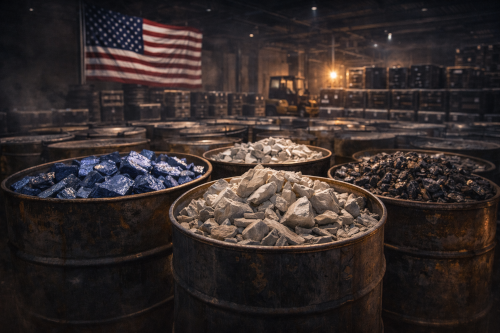
His announcement was simple: Project Vault and $12 billion that would help us stockpile critical minerals.
Just as we’ve had a strategic petroleum reserve for crude oil, now we’re about to create a reserve for strategic minerals.
The playbook’s the same, just different commodities.
Except our adversary isn’t OPEC any longer.
It’s China.
Arming Trump’s Next War
Right now our dependence on the resources to control our batteries, semiconductors, and weapons systems is wholly dependent on China.
After all, China controls roughly 70% of rare earth mining and 90% of processing capacity.
And unlike oil, you can’t drill your way out of a rare earths shortage within a few months.
However, the real wake-up call came in 2025 during trade negotiations.
That’s when Beijing banned exports of antimony — the stuff that goes into missiles and munitions. They also restricted gallium and germanium, critical for semiconductors and fiber optics. U.S. defense contractors scrambled to secure new supply as rare earth prices spiked.
The smart money is paying attention to that vulnerability.
Although Project Vault is the centerpiece for Trump’s ambitions, it’s not the whole story.
He’s planning to build a complete system — from stockpiling the minerals, investing in the producers, and guaranteeing their revenue, to clearing the permitting roadblocks that killed U.S. mining for decades.
But here’s how Project Vault actually works.
The Export-Import Bank (EXIM) approved a $10 billion direct loan — the largest in EXIM’s history (double the previous record), with private capital kicking in another $2 billion from commodity firms like Hartree Partners, Traxys, and Mercuria.
Companies request minerals to be stockpiled at fixed prices.
So let’s say a manufacturer wants 500 metric tons of lithium at $10,000 per ton. Then Project Vault buys and stores it until a company withdraws the lithium and pays $5 million to replenish at that same fixed price.
What that does is lock in pricing, kills volatility, and shields manufacturers from supply shocks.
GE Vernova, Boeing, Clarios, and Western Digital already signed on.
But here’s the catch… You can’t stockpile what you can’t produce. That’s where the federal equity stakes come in.
The Pentagon now owns 15% of MP Materials — which owns California’s Mountain Pass mine and is the only U.S. mine-to-magnet rare earth producer.
MP gets a 10-year price floor at nearly double China’s market price. If market prices fall, taxpayers cover the difference. The company’s building a second magnet plant with 10 times its current capacity.
Meanwhile, the Commerce Department took a 10% stake in USA Rare Earth with a $1.6 billion package. The company’s Round Top deposit in Texas holds heavy rare earths like dysprosium and terbium, plus lithium, beryllium, and gallium.
The mine goes operational in 2028, with processing in Colorado.
The deals just kept rolling in, too.
The Energy Department grabbed 5% of Lithium Americas and another 5% of its joint venture with GM. For a little perspective, Lithium’s Thacker Pass mine in Nevada will pump out 40,000 metric tons of lithium carbonate per year with a $2.26 billion federal loan backing it.
Interior invested $36.5 million for 10% of Trilogy Metals and it’s Ambler Mining District in Alaska.
Remember the 211-mile Ambler Road we talked about recently, which was approved in October 2025 after Biden killed it?
Well, now the federal government’s considering financing the entire $2 billion road. Keep in mind that the deposit holds 9 billion pounds of copper, plus cobalt, zinc, and lead.
In other words, the EXIM financing machine is cranking.
They’ve issued $14.8 billion in letters of interest for critical minerals projects, including $455 million for rare earth processing inside the U.S., $400 million for lithium extraction in Arkansas, and $350 million for cobalt and nickel production in Australia.
Then we have a veritable permitting revolution taking place.
Resolution Copper in Arizona — a joint venture between Rio Tinto and BHP — just completed its land swap in March 2026.
For the record, that’s 40 billion pounds of copper, enough to supply 25% of U.S. needs for decades.
The project was stuck in the mud for 12 years, until Trump cleared it in a few months.
More than 20 critical mineral projects were added to the FAST-41 expedited permitting dashboard.
The goal here is clear: Compress the average 29-year U.S. mine permitting timeline down to months.
The Strategic Petroleum Reserve proved the model works.
Release oil during the 1991 Gulf War, Hurricane Katrina, the Libyan crisis, the Russia-Ukraine war, and the current Third Gulf War — stabilize markets, try to prevent shocks.
This is the same playbook, folks.
The federal framework eliminates traditional mining risks by alleviating permitting hell, price crashes, financing gaps, demand uncertainty — all gone for companies in the system.
The highest-conviction plays are the federal equity portfolio…
MP Materials with Pentagon ownership and price floor protection, USA Rare Earth with its Commerce Department backing and a $1.6 billion package, Lithium Americas with the Energy Department stake and a $2.26 billion loan, and Trilogy Metals with the Interior’s investment and a federally financed road potentially coming.
Going forward, we’ll continue seeing more and more deals coming out of Project Vault, and you know as well as I do that fixed-price contracts mean revenue certainty.
More importantly, it cuts our exposure to Chinese price manipulation.
And then of course there’s the FAST-41 permitting fast-track, which is is relieving that permit choke point.
But here’s the thing…
The Strategic Petroleum Reserve took 40-plus years to build and proved its worth repeatedly.
Project Vault is the SPR for the electric age.
And you can bet the smart money is still positioning themselves for the next mining boom.
Let me show you what they’re looking at.
Until next time,

Keith Kohl
 Check us out on YouTube!
A true insider in the technology and energy markets, Keith’s research has helped everyday investors capitalize from the rapid adoption of new technology trends and energy transitions. Keith connects with hundreds of thousands of readers as the Managing Editor of Energy & Capital, as well as the investment director of Angel Publishing’s Energy Investor and Technology and Opportunity.
For nearly two decades, Keith has been providing in-depth coverage of the hottest investment trends before they go mainstream — from the shale oil and gas boom in the United States to the red-hot EV revolution currently underway. Keith and his readers have banked hundreds of winning trades on the 5G rollout and on key advancements in robotics and AI technology.
Keith’s keen trading acumen and investment research also extend all the way into the complex biotech sector, where he and his readers take advantage of the newest and most groundbreaking medical therapies being developed by nearly 1,000 biotech companies. His network includes hundreds of experts, from M.D.s and Ph.D.s to lab scientists grinding out the latest medical technology and treatments. You can join his vast investment community and target the most profitable biotech stocks in Keith’s Topline Trader advisory newsletter.


