

In April 1945, General Patton’s men were chasing the last convulsions of a dying Nazi army through a German village called Merkers.
The U.S. soldiers were expecting it all — ambushes, booby traps and stubborn Wehrmacht holdouts.
Instead, the locals kept murmuring something about salt mines.
After locating and then blowing apart the entrance to the mine with dynamite, what they found underground was like a scene straight out of a classic heist film.
Gold bars stacked like masonry, canvas bags of coins slumped against the walls, foreign currency bundled for export, and crates packed with jewelry stripped from victims across Europe.
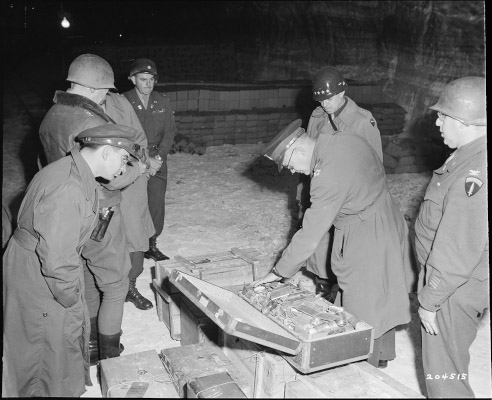
The official ledger later estimated the haul in the billions of today’s dollars, but the more important figure was zero — as in, zero trust in the future, and zero faith in currency.
There’s a reason the Nazis were hiding such a vast treasure hoard, and that’s the kind of value gold represents when institutions falter.
Today, gold’s relevance hasn’t faded in the slightest. In fact, it simply migrated from mine shafts to vaults and trading terminals, and in 2026 it carries the same subtext as it did in 1945 — a hedge against political turbulence and monetary theater.
For us, that’s why gold’s march through $4,600 per ounce recently isn’t surprising.
And with the next technical resistance near $4,800 per ounce, it may be only a matter of days or weeks until we test that level.
Right now, there’s another Merker’s story being played out.
And as this one unfolds, gold’s next stop will be $5,000.
Fast-forward from German villages to Swiss vaults.
That instinct to hide a golden treasure hasn’t diminished in the least.
Between 2013 and 2016, Nicolás Maduro quietly shipped 113 metric tonnes of Venezuelan central bank gold to Switzerland — the kind of “just in case” allocation you make when you start to see the cracks start to appear.
By 2016, Maduro’s golden treasure was worth nearly $6 billion… and last week Switzerland ordered those assets frozen.
If you think that was Maduro’s only fallback plan, think again.
The former unrecognized dictator of Venezuela also squirreled away more than 30 tonnes of Venezuelan gold into vaults in the United Kingdom.
Of course, the fate of that trove is now in limbo, and it’ll be years of legal battles, diplomatic sparring, and courtroom theater.
Think of it as a form of geopolitical Schrödinger’s gold — present, but unusable.
The parallels to Merkers Mine aren’t lost on us, because when you see the writing on the wall, gold suddenly becomes your best store of value.
Look, history keeps rerunning this scene for a reason.
The Best Free Investment You’ll Ever Make
Our analysts have traveled the world over, dedicated to finding the best and most profitable investments in the global energy markets. All you have to do to join our Energy and Capital investment community is sign up for the daily newsletter below.
Meanwhile, markets have been writing a separate script recently…
Gold entered 2026 grinding upward on structural tailwinds: central banks buying like it’s the late 1970s, sovereign wealth funds expanding allocations, and ETFs waking up after years of apathy.
Naturally, this was on top of the geopolitical chaos taking place, from Gaza volatility, missile strikes near shipping lanes, contested elections, and a steady drip of diplomatic escalation in Eastern Europe and the Pacific.
Then this week, something came up that is proving to be even more potent — President Trump’s willingness to lean on the Federal Reserve.
You know as well as I do that nothing rattles institutional capital quite like the possibility — or even the illusion — of compromised central bank independence.
When the dollar wobbles, gold shines.
Believe me, the FOMO is real.
Funds that swore off metals are quietly rotating in, and retail traders who once mocked bullion as “boomer Bitcoin” now whisper about allocation strategy. Gold is no longer a hedge in these conversations. It’s a core position.
That’s how the $4,800/oz price target turns into next week’s conversation, and $5,000 becomes a Q1 thesis.
But I want you to look beyond that.
Here’s the irony: Maduro’s golden stash shows that physical gold remains the most powerful store of value today.
Gold protects wealth across regimes and generations, but it still comes with its own drawbacks — it settles slowly, triggers lawsuits, and invites political interference.
Digital gold fixes the bottleneck without sacrificing the asset.
Think about it…
Tokenized gold — such as NatGold — gives investors the same metal, the same reserve backing, and the same monetary character… but with zero of the headaches of traditional gold.
We’re talking instant settlement, fully transparent auditing via the blockchain, and zero diplomatic overhead.
Central banks know this. Sovereign funds know it. Trading desks know it.
Now you do.
In other words, Merkers Mine and Maduro’s billion-dollar gold hoard are the old model: Digital gold is the new one.
And as gold marches toward $5,000, the question shifts from “should I own gold?” to “what form of gold will give me liquidity when it matters?”
That’s why NatGold isn’t a gimmick or a coupon, but rather the missing rail: physical, audited, blockchain-verified, and built for a world where capital moves at the speed of light.
And the gold bugs out there bragging about their own golden stashes won’t be lining up at pawn shops, they’ll be logging into a dashboard.
If you’re looking for the same powerful hedge, the optionality, and the escape hatch before $5,000 gold becomes the headline, you reserve NatGold.
And you can learn all the details — absolutely free of charge — behind this opportunity right here.
Until next time,

Keith Kohl
 Check us out on YouTube!
A true insider in the technology and energy markets, Keith’s research has helped everyday investors capitalize from the rapid adoption of new technology trends and energy transitions. Keith connects with hundreds of thousands of readers as the Managing Editor of Energy & Capital, as well as the investment director of Angel Publishing’s Energy Investor and Technology and Opportunity.
For nearly two decades, Keith has been providing in-depth coverage of the hottest investment trends before they go mainstream — from the shale oil and gas boom in the United States to the red-hot EV revolution currently underway. Keith and his readers have banked hundreds of winning trades on the 5G rollout and on key advancements in robotics and AI technology.
Keith’s keen trading acumen and investment research also extend all the way into the complex biotech sector, where he and his readers take advantage of the newest and most groundbreaking medical therapies being developed by nearly 1,000 biotech companies. His network includes hundreds of experts, from M.D.s and Ph.D.s to lab scientists grinding out the latest medical technology and treatments. You can join his vast investment community and target the most profitable biotech stocks in Keith’s Topline Trader advisory newsletter.


