

It’s time to call bullshit… on everyone.
Nearly a week after the historic release of strategic oil reserves was announced by the IEA, we knew it was only a matter of time before the cracks started to emerge in their grand plan to save the world from soaring oil prices.
When it was first announced, the headlines were flooded with ignorant optimism.
To the average person, what wasn’t there to love? 400 million barrels is HUGE, right? Historic… right?
After all, never before in history has there been this kind of move by the IEA.
The first time the IEA unleashed oil reserves from members’ stockpiles was back in 1991 during the first Gulf War. Then it wasn’t until 2005’s Hurricane Katrina that action was again taken, then again in 2011 during the Libyan Civil War.
All was quiet for the next decade, until Russian tanks started rolling onto Ukrainian soil, when 182.7 million barrels was released in March and April of 2022. 
However, all of those “energy crises” were peanuts compared to what’s going on right now as more than 20 million barrels are locked-in.
For the record, this 400-million barrel release was nothing more than a hail mary, and the market is starting to call the IEA’s bluff.
Rather than calming prices, WTI crude rose above $95 per barrel by the end of the day.
Look, when the biggest coordinated reserve release in five decades can’t even keep prices down for 24 hours, something’s broken in the math.
And when you dig into what the IEA is actually promising versus what it can physically deliver, you realize this isn’t a rescue operation.
Why? Because what we’re looking at is nothing more than an IEA shell game designed to buy time while everyone crosses their fingers hoping the Third Gulf War ends before anyone notices the shells are empty.
Let me show you exactly how this falls apart.
The Best Free Investment You’ll Ever Make
Our analysts have traveled the world over, dedicated to finding the best and most profitable investments in the global energy markets. All you have to do to join our Energy and Capital investment community is sign up for the daily newsletter below.
The IEA’s 400-Million-Barrel Bluff
Taking the IEA’s announcement at face value, a 400-million barrel release from 32 member nations, unanimously approved, is undoubtedly the largest coordinated release in the agency’s history.
But here’s what they didn’t put in the headline — there’s a few issues, actually.
First, let’s take a look at where all that oil is coming from:
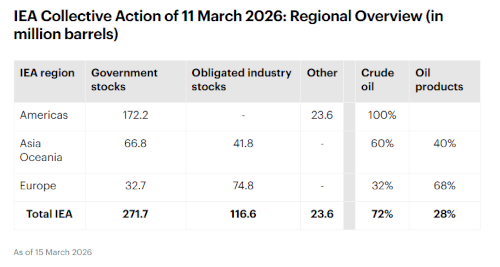
The United States’ 172-million barrel release from our SPR will account for roughly 63% of the IEA’s announced plan. According to U.S. Energy Secretary Chris Wright, it’ll take about 120 days to draw down that much crude (starting later this week, of course).
Do that math with me…
172 million barrels ÷ 120 days = 1.43 million barrels per day.
That’s it. That’s the flow rate we can expect. And the thing is, our crude can’t flow any faster without risking damage to the underground salt caverns where the oil is stored.
Meanwhile, the Strait of Hormuz — which normally handles over 20 million barrels per day of crude oil transit — has been effectively closed since February 28th when the war began.
You see the problem now, right?
Now add in another 23.6 million barrels that’ll come out of Canada. Except, the Canadian release isn’t exactly a release at all, but rather it’s simply the expected production growth from the oil sands this year.
That’s more than half of the IEA’s ammunition trickling out and stranded halfway across the world from where it needs to be.
The IEA is trying to replace 20 million barrels per day of lost transit with a release that flows at 1.4 million barrels per day for exactly four months before its exhausted.
Trust me, the numbers get worse when you look at where the rest of that “400 million barrels” is coming from.
South Korea committed 22.46 million barrels — a record release for them. Meanwhile, Japan’s oil is going to stay within their domestic market to help offset lost supply from the Strait ofHormuz. Their daily oil imports typically run around 2.5-3 million barrels per day. This release represents about 7-9 days of their normal consumption.
The United Kingdom pledged 13.5 million barrels that’ll flow into European markets, where Brent crude already trades above $100 per barrel.
Don’t get me wrong, every barrel helps, but what the IEA is calling a “coordinated” release is actually 32 countries fighting their own fires with their own garden hoses while the entire Persian Gulf burns.
The barrels aren’t going where they’re needed most, they’re going where they’re stored.
What should terrify us all isn’t the half-hearted attempt by IEA members to put out this fire in the Middle East.
No, dear reader, the horrifying repercussions will come if Iran is able to extend this war beyond March.
The longer that maritime traffic through the Strait remains choked, the greater the consequences.
For Iraq, oil production dropped from 4.3 million barrels per day to 1.2 million barrels per day.
That’s 3.1 million barrels per day shut in — gone.
But this isn’t due to Iraqi fields’ inability to extract oil, but because their storage tanks filled up and there’s nowhere for the oil to go when tankers can’t reach the export terminals.
Think about it this way, Iraq’s production shut-ins ALONE are more than double the daily flow rate from the entire announced release from the U.S. SPR.
And Iraq isn’t alone.
Kuwait usually exports about 3 million barrels per day of oil and petroleum products — all of it entirely reliant on the Strait of Hormuz. Their exports have effectively stopped.
The UAE has shut in 640,000 barrels per day of production capacity because storage is full and tankers aren’t loading.
Saudi Arabia is the only major Persian Gulf producer with a workaround.
Fortunately for them, they’re diverting unprecedented volumes through the East-West Pipeline to the Red Sea coast at Yanbu. The pipeline can technically handle 7 million barrels per day, which would cut Saudi production by about 5 million barrels per day if fully utilized.
But here’s another bottleneck nobody’s talking about: the Yanbu terminal can only load about 4.5 million barrels per day. In other words, the pipeline capacity doesn’t matter if the ships can’t load the crude fast enough.
Shipments from Saudi western terminals have surged to about 2.3 million barrels per day so far this month according to ship-tracking data. That’s helpful. It’s also a fraction of what the kingdom normally exports through the Persian Gulf.
Qatar, which is one of the world’s largest LNG exporters, has declared force majeure on deliveries. The IEA estimates global LNG supply has been reduced by 20%, forcing Asian buyers to compete with Europe for available cargoes.
According to the IEA, roughly 8 million barrels per day of crude is shut in, with another 2 million barrels per day of condensates and natural gas liquids offline.
That’s a minimum of 10 million barrels per day removed from global markets.
The IEA’s 400 million barrel release, flowing at maybe 3-4 million barrels per day combined across all member nations for a few months, doesn’t replace that.
The world can’t replace that, folks.
And despite the fact that a barrel of WTI is trading just shy of $100 per barrel, and Brent crude is slightly north of that price, if you want a look at the real price damage this war is unleashing, keep in mind that a barrel of DME Oman is nearly $150 per barrel.
In fact, the basket of OPEC crude is trading for nearly $130 per barrel right now.
The math is brutally simple: you cannot compensate for losing 10 million barrels per day of supply with a four-month release flowing at 3-4 million barrels per day.
The Hidden Oil Gem Still Pumping Value
Look, the IEA’s 400-million barrel release represents roughly one-third of member nations’ total government-held strategic reserves of 1.2 billion barrels.
Let’s not sugarcoat this — it’s a one-shot move.
If the Strait of Hormuz remains closed beyond April, the IEA will have burned through its largest-ever reserve release and accomplished exactly nothing except temporarily masking the scale of the supply crisis.
Then what?
Even after President Trump lifted sanctions on Russian crude exports, we’re only talking about another 2 million barrels per day or so that will flow back to global markets — and the cash will go right back into Putin’s war chest.
In fact, Putin can now sell oil at massive premiums while Ukraine helplessly watches its biggest supporter hand Russia an economic lifeline.
And here’s the catch — even with Russian barrels flowing and strategic reserves draining, the math STILL doesn’t work if the strait stays closed.
The Trump administration is betting big that this oil transit problem is only temporary.
That’s the bet, and the only strategy they’ve come up with is to release enough reserves to prevent panic buying and price spikes for a few weeks hoping this war stays within their 6-week timeframe.
If they’re right, oil prices should stabilize in the $80-90 range.
If they’re wrong — if this war extends into late April or May — then the largest strategic reserve release in history will be exhausted, OPEC spare capacity will remain stranded behind a closed strait (except, of course, for the Iranian tankers that are allowed to export oil to India and China) and oil prices will have nothing left to cushion the spike.
The thing is, nobody actually knows how long this war will last.
Trump says we’re “way ahead of schedule.”
Iranian officials promise to intensify retaliation and that the strait will remain closed.
The only certainty in this mess is that anyone telling you they definitively know what will happen next is lying to you.
The Permian Advantage: Where Oil Supply Actually Matters
Now let’s look at the reality for U.S. consumers — the truth is that we don’t import much oil from the Persian Gulf.
America is the world’s largest oil producer…. And we’re also the world’s largest consumer.
However, our imports come primarily from Canada, Mexico, and other Western Hemisphere sources.
Our exposure to oil exports from the Middle East are limited.
The Strait of Hormuz crisis is devastating for Asia and Europe, but for us, it’s a price problem, not a supply problem.
That makes domestic production from our most prominent oil-producing regions like the Permian Basin absolutely critical to keeping a lid on U.S. gasoline prices.
Yet, you know just as well as I do that the real challenge is that U.S. oil output has been flat or declining for a year due to the fact that oil has been incredibly cheap. Operators slowed drilling, and completion schedules stretched out as growth stalled in 2025.
You can’t suddenly flip a switch and add 500,000 barrels per day of new production overnight. Drilling takes time. Completions take time. Even the fastest operators in the Permian need a few months to bring new production online — and that’s assuming companies decide that it’s worth it to increase activity over the short-term.
Those oil gems in the Permian patch that were already growing before this crisis — the ones with inventory ready to complete, with drilling programs that didn’t slow down when prices sagged — are the players positioned to benefit from the higher oil prices that will persist as this war drags on.
Don’t get me wrong, this isn’t a call for celebration. High oil prices hurt consumers, strain the economy, and impose real costs on real people filling up their tanks.
But here’s the thing… Finding those small, efficient Permian operators still flying under Wall Street’s radar may be easier than you think.
You just need to know where to look.
Until next time,

Keith Kohl
 Check us out on YouTube!
A true insider in the technology and energy markets, Keith’s research has helped everyday investors capitalize from the rapid adoption of new technology trends and energy transitions. Keith connects with hundreds of thousands of readers as the Managing Editor of Energy & Capital, as well as the investment director of Angel Publishing’s Energy Investor and Technology and Opportunity.
For nearly two decades, Keith has been providing in-depth coverage of the hottest investment trends before they go mainstream — from the shale oil and gas boom in the United States to the red-hot EV revolution currently underway. Keith and his readers have banked hundreds of winning trades on the 5G rollout and on key advancements in robotics and AI technology.
Keith’s keen trading acumen and investment research also extend all the way into the complex biotech sector, where he and his readers take advantage of the newest and most groundbreaking medical therapies being developed by nearly 1,000 biotech companies. His network includes hundreds of experts, from M.D.s and Ph.D.s to lab scientists grinding out the latest medical technology and treatments. You can join his vast investment community and target the most profitable biotech stocks in Keith’s Topline Trader advisory newsletter.


