
Editor’s Note: Before you start your report “The Nuclear Bottleneck: 3 Stocks Cashing In on America’s $1 Trillion AI Power Crisis”, we wanted to share this note about a related investment opportunity that you might want to hear about. You can skip below to the report, but we urge you to take 30 seconds to learn about this unique energy play…
President Trump lit the fuse on what could become the biggest U.S. nuclear boom in 50 years.
With a sweeping Executive Order, he declared:
“It is the policy of the United States to expedite and promote… nuclear energy to provide affordable,
reliable, safe, and secure energy to the American people.”
Red tape? Slashed.
Licensing? Fast-tracked to just 18 months.
New reactors? Approved on federal land nationwide.
But here’s what most investors are missing…
This isn’t just about small modular reactors (SMRs).
Trump made it clear: “We’re also talking about the big plants — the very, very big, the biggest.”
Only ONE under-the-radar company is built for both.
- It already operates seven full-scale nuclear reactors
- It’s deploying next-gen SMRs to power Amazon’s $35 billion AI data center expansion.
That means DOUBLE the exposure — and a chance to lock in real cash payouts from government-backed contracts.
This is a once-in-a-generation opportunity to ride Trump’s energy boom from the ground floor.
The Nuclear Bottleneck: 3 Stocks Cashing In on America’s $1 Trillion AI Power Crisis
Let me tell you something they’re not putting on the front page of the Wall Street Journal.
Last summer, I sat across the table from a senior engineer at one of the largest utility companies in the country. He’d had three glasses of bourbon by the time he leaned in and told me the part nobody outside the industry will say out loud:
“We can’t power this. Not even close.”
He was talking about the artificial intelligence buildout. The hyperscale data centers. The Stargate project. The $500 billion Microsoft-OpenAI alliance. The Meta supercluster in Louisiana. The Amazon cloud expansion that’s already eating Virginia’s grid.
You’ve seen the headlines. You’ve seen Nvidia stock. You’ve probably watched ChatGPT or Claude or Gemini run a thousand queries this month and never once thought about where the electricity comes from.
But somebody has to power all of it.
And the people whose job it is to keep the lights on in this country are starting to panic.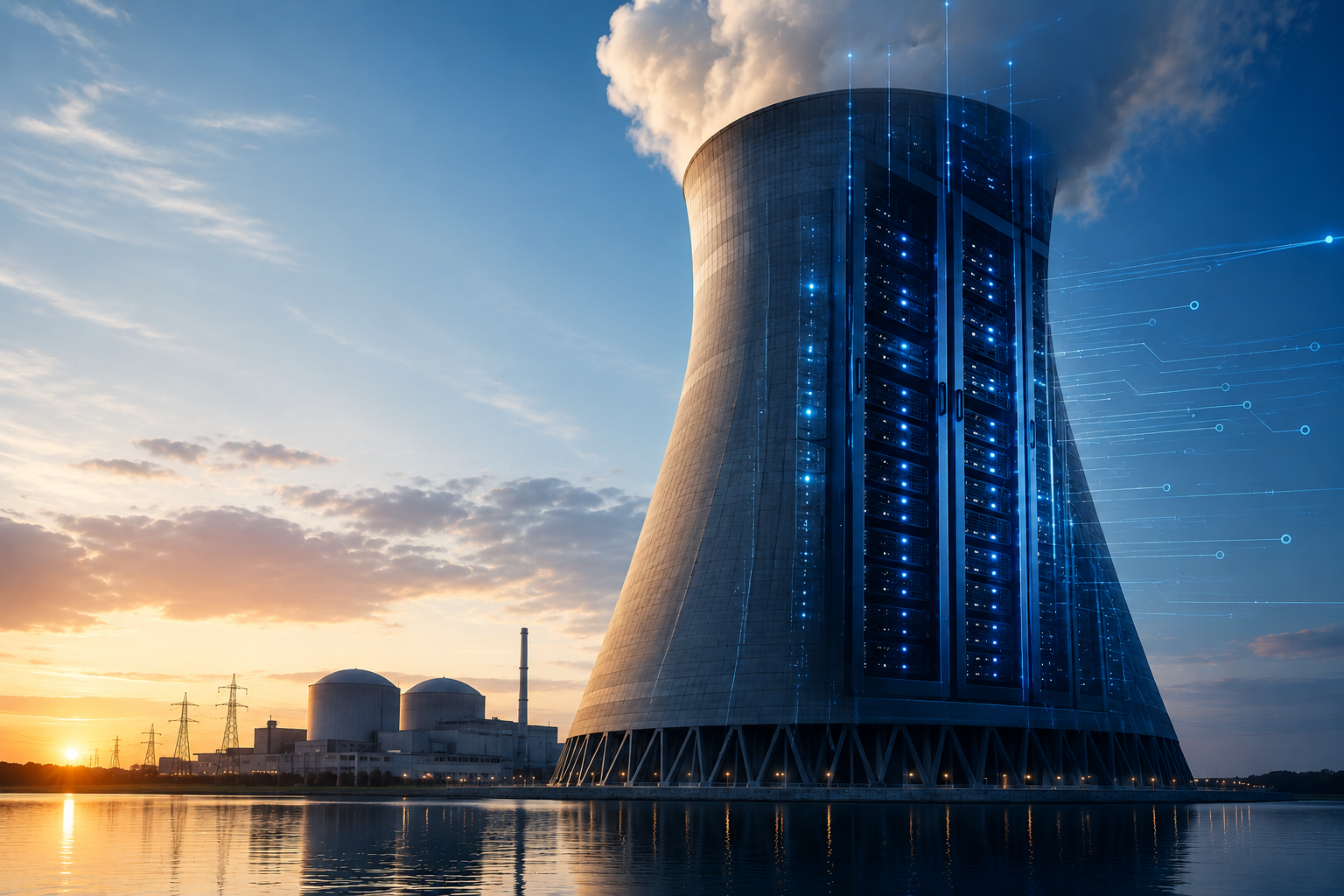
The 165% Problem
Let me give you the number that put me on this story.
Goldman Sachs forecasts data center power demand will grow 165% by 2030.
That’s not “double.” That’s two and a half times the entire current load. And we’re not talking 30 years out — that’s four years from now.
The International Energy Agency just confirmed that data center electricity consumption surged 17% last year alone. AI-focused centers grew faster than that. And by 2030, AI workloads are expected to consume more than 10% of all U.S. electricity — up from roughly 4% today.
Now ask yourself: where is that power going to come from?
It’s not coming from coal. The plants are being shut down faster than they can be permitted.
It’s not coming from solar. Every honest grid engineer in the country will tell you intermittent renewables can’t carry baseload AI compute that runs 24 hours a day, 365 days a year, at 99.999% uptime.
And it can’t all come from natural gas, either — though gas is going to play a huge role. Pipeline capacity is constrained. Combined-cycle plants take 3-5 years to build. The interconnect queue at most ISOs is backed up past 2030.
That leaves one source. The only one that runs 24/7, produces zero carbon, and scales to gigawatt loads.
Nuclear.
And here’s the part Wall Street is just starting to wake up to: there isn’t enough of it.
The Bottleneck Nobody Saw Coming
I’ve been covering uranium and nuclear power for almost 20 years. I’ve walked the mine sites in Saskatchewan. I’ve toured the conversion facilities. I’ve sat through the conference calls where utility CEOs swore the “nuclear renaissance” was just around the corner — and watched it die three times.
This time is different.
This time, the demand isn’t coming from a feel-good climate policy or a politician’s promise. It’s coming from the most ruthless capital allocators on Earth — Microsoft, Amazon, Google, Meta — and they are writing checks today to lock up nuclear capacity for the next 20 years.
The data tells the story:
– Uranium spot prices spiked above $100/lb in January 2026 — a level not seen since the 2007 bubble. And this time, it’s not speculation. It’s utilities and financial buyers competing for physical pounds.
– Cameco — the world’s second-largest uranium producer — was up 151% over the past year, and its president recently told analysts that “uncovered requirements” (future demand not yet locked into contracts) have hit record levels.
– Microsoft signed a 20-year power purchase agreement to restart Three Mile Island Unit 1. Read that sentence twice. They are reopening a reactor that was shut down in 2019 specifically to feed AI.
– The pipeline of conditional offtake agreements between data center operators and small modular reactor developers has nearly doubled in 12 months — from 25 gigawatts at the end of 2024 to 45 gigawatts today.
This is the early innings of a structural supply shock. Sprott projects a cumulative uranium deficit of nearly 200 million pounds by 2040. And the new mines required to close that gap take 10-15 years to permit and build.
The math doesn’t work. Demand is here now. Supply takes a decade.
That’s the bottleneck.
And it’s exactly the kind of imbalance that makes a handful of well-positioned companies enormously profitable.
I’ve identified three of them.
Stock #1 — Cameco Corporation (NYSE: CCJ)
The Pick-Axe Seller of the AI Power Boom
If AI is the gold rush, Cameco is selling the pick-axes — and the picks happen to be radioactive.
Cameco controls some of the largest, highest-grade uranium deposits on the planet. McArthur River. Cigar Lake. Inkai. These aren’t speculative drill plays. They are operating mines, producing today, with proven reserves measured in hundreds of millions of pounds.
But Cameco isn’t just a miner. Through its 49% stake in Westinghouse Electric, Cameco now sits at the center of the entire Western nuclear fuel cycle — mining, conversion, enrichment, fuel fabrication, and reactor servicing. When a U.S. utility signs a deal to power an AI data center, Cameco gets paid five different times along the way.
What I like about it:
– The contract book is loading up. Cameco has been signing long-term sales agreements at floor prices well above current spot — and ceilings in the $130-$140/lb range. Those are the highest contract terms the industry has seen in over a decade.
– Q1 2026 production guidance came in strong, and the company has the operational flexibility to dial up output as prices rise.
– Westinghouse’s AP1000 reactor is the leading large-reactor design for the next wave of utility-scale plants — and Westinghouse services nearly half the world’s existing reactor fleet.
The risk: Uranium is a volatile commodity. Cameco shares move with spot prices, which means short-term pullbacks of 15-25% are part of the deal. Long-term holders have been rewarded; traders have been whipsawed. Size your position accordingly.
This is the cleanest large-cap way to play the structural uranium shortage I see playing out over the next three to five years.
Stock #2 — Constellation Energy (NASDAQ: CEG)
The Landlord of America’s Existing Nuclear Fleet
If Cameco is the pick-xe, Constellation is the landlord.
Constellation operates the largest fleet of nuclear reactors in the United States — 21 reactors across 13 sites. While everybody else is talking about the small modular reactors that might be online by 2030, Constellation is selling power today from plants that already exist and are already paid off.
Here’s what that means in practice. Their cost to produce a megawatt-hour of nuclear electricity is locked in at a level far below what hyperscalers are willing to pay for guaranteed 24/7 carbon-free power. So Constellation is doing what any rational landlord with a hot property does: they’re raising the rent.
The Microsoft-Three Mile Island deal got the headlines, but it was just the opening shot. Constellation has a multi-year runway of:
– Re-contracting expiring PPAs at much higher prices (utility-scale power contracts signed five to ten years ago are repricing at 2-3x as they roll off)
– Direct-to-hyperscaler deals that bypass the wholesale market entirely and capture premium pricing
– Uprates — squeezing 5-10% more output from existing reactors at very low cost
– Subsidies and capacity payments under the Inflation Reduction Act that put a floor under nuclear economics
What I like about it:
– This is a real business with real cash flow. Unlike pre-revenue SMR companies, Constellation generates billions in free cash flow today and is buying back stock aggressively.
– The earnings power is just starting to inflect. Wall Street’s 2026-2028 estimates are climbing, but I think they’re still too low — analysts are using outdated assumptions about wholesale power prices.
– The strategic value is enormous. Constellation’s existing fleet is essentially impossible to replicate. You cannot permit and build 21 nuclear reactors today, even if you had unlimited money.
The risk: The stock has had a tremendous run already. Don’t chase it — accumulate on pullbacks. Any general market correction will give you a better entry.
If I could only own one nuclear stock for the next five years, this might be it.
Stock #3 — BWX Technologies (NYSE: BWXT)
The Profitable Picks-and-Shovels of the SMR Buildout
Here’s where I’ll separate myself from every other newsletter pitching nuclear stocks right now.
You’ve seen the ads for NuScale Power. You’ve seen the ads for Oklo. They are exciting stories. They are also pre-revenue, cash-burning, and a decade or more from generating real earnings.
I want to point you to the boring company. The one that’s already profitable. The one that gets paid no matter which SMR design wins.
BWX Technologies is the largest manufacturer of nuclear reactor components in North America. They build the reactors that power U.S. Navy submarines and aircraft carriers — a business that’s been a steady cash cow for decades. And now, they’re translating that manufacturing expertise into the commercial SMR boom.
BWXT has already been selected:
– By GE Hitachi to manufacture components for the BWRX-300 SMR (the leading U.S. design for utility-scale deployment)
– By NuScale as a key fabrication partner for the VOYGR plant
– By the Department of Energy for advanced fuel manufacturing contracts
What I like about it:
– BWXT generated $3.19 billion in revenue in 2025, up 18% year-over-year, with EPS up 20%. This is not a story stock — it’s a real cash machine.
– They get paid as a manufacturer, not a developer. They don’t have to win the SMR design competition. They just have to fabricate the parts. As more designs move through the regulatory process, BWXT’s order book grows.
– The U.S. Navy business alone — submarine and carrier reactor refueling — is a recession-proof, multi-decade contract base that essentially funds the company’s commercial nuclear pivot.
– Defense plus AI plus nuclear is one of the cleanest exposure cocktails I can find on the entire NYSE.
The risk: It’s not a moonshot. Don’t expect 5x returns in a year. This is a steady compounder for the patient investor who wants real earnings backing the nuclear thesis.
If you want a “sleep at night” position in the AI nuclear story, BWXT is the one to own.
How I’d Position This Portfolio
Three stocks. Three different exposures. One thesis.
Here’s how I’d think about a position:
– Cameco (CCJ) — your direct uranium leverage. Higher volatility, biggest upside if spot prices keep climbing.
– Constellation Energy (CEG) — your blue-chip cash-flow nuclear play. The compounder.
– BWX Technologies (BWXT) — your low-volatility picks-and-shovels base. The defensive earnings backbone.
Across all three, you’ve got the entire value chain: the fuel, the fleet, the manufacturing.
If the nuclear renaissance plays out the way I expect — and the math of AI power demand says it has to — every one of these companies has years of structural tailwind ahead.
This is not a six-month trade. This is the energy story of the decade. The investors who position correctly now, before the rest of Wall Street figures out the math, are going to look very smart in 2028 and 2029.
I’ll be following all three closely in Energy and Capital in the weeks ahead. Watch your inbox for updates, entry-point alerts, and the occasional pulled-from-the-field story you won’t read anywhere else.